
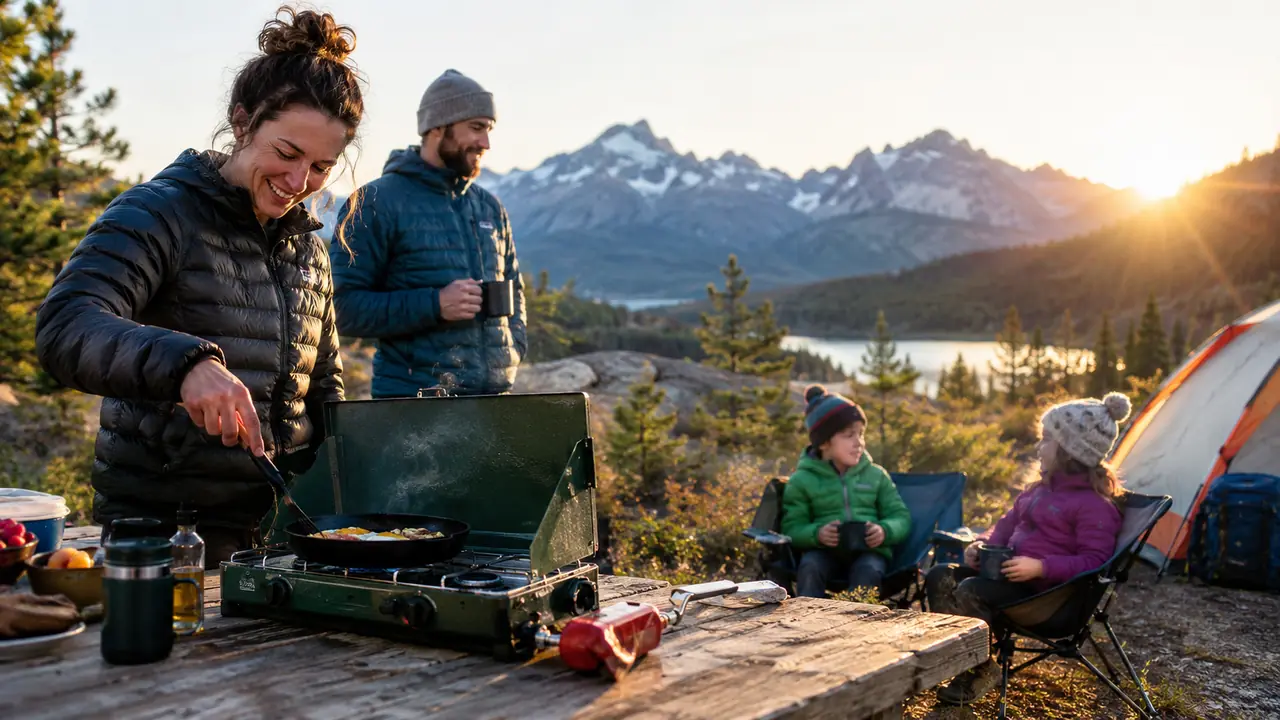
Every summer we pack the Ford Expedition and head to a state park somewhere in Utah, Idaho, or Wyoming. Five kids, ages 4 to 15, one rooftop cargo box, and a long list of things that need to happen before anyone has fun. The hardest part of the whole trip is usually breakfast. Not because the kids are cranky, though they are. It is because cooking for seven people on a camp stove takes longer than anyone expects, and by the time the eggs are done, the pancakes are cold.
After about twelve years of camping with our family, I have landed on a setup that works. The center of it is the Camp Chef Explorer 2-Burner Outdoor Camping Stove. It puts out 60,000 total BTUs, which is a lot of heat for a campsite. That heat is what makes feeding a crowd possible instead of a three-hour project. This article is not about gourmet camping food. It is about getting a hot breakfast on the table for a big family without losing your whole morning. These are the steps that work for us.
The stove that feeds our whole crew
The Camp Chef Explorer 2-Burner has enough heat to run a griddle and a pan at the same time. That is the difference between breakfast at 8 and breakfast at 10.
Amazon Check Today's Price on Amazon →Why the Camp Chef Explorer handles a crowd
I have cooked breakfast on a lot of stoves over the years, from a single-burner butane model to a borrowed RV stove. The Camp Chef Explorer is the first one that felt like it was built for the way we actually camp. The two burners are spaced far enough apart that a large griddle sits across both, and the 60,000 total BTUs mean the griddle stays hot even when the air is cold and the wind is up.
The other thing I appreciate is the height. The stove sits on legs, so the cooking surface is at a comfortable level. I do not have to crouch over a tiny table to flip pancakes. That matters when you are cooking for twenty minutes straight. My back thanks me, and I am less likely to rush the food.
It is not the lightest stove we own, and it takes up real space in the back of the Expedition. But for car camping, that is a trade I am happy to make. The heat output and the stable cooking surface are worth the trunk space. If you are backpacking, this is not the stove for you. If you are feeding a family at a state park, it is exactly right.
Step 1: Plan a menu that uses one heat source at a time
The biggest mistake I made early on was trying to cook like I do at home. At home I have four burners, an oven, and a microwave. On a camp stove I have two burners, and if I am honest, usually one because the other is holding the coffee pot. So now I plan breakfast around a single cooking surface, even though the Camp Chef has two.
That means choosing between pancakes, eggs, or a one-pan scramble, not all three at once. Our usual menu is a big batch of scrambled eggs with sausage, plus a stack of pancakes cooked on a griddle. I cook the sausage first, then the eggs, then the pancakes. The order matters. Sausage leaves the most grease, so it goes first. Eggs pick up flavor from the pan. Pancakes go last because they are the fastest to dry out.
If you want to get fancy, a breakfast burrito bar works well too. Cook the filling in one pan, warm the tortillas in a skillet or foil on the other burner, and let everyone build their own. The point is to pick a menu that does not need three things cooking at once.
One more thing about the menu: keep it familiar. Camping is not the time to introduce a complicated new recipe. The kids eat better when they recognize the food, and you cook faster when you do not have to read a recipe. Our go-to is the same breakfast we make at home on a busy Saturday, just scaled up.
Step 2: Prep the night before
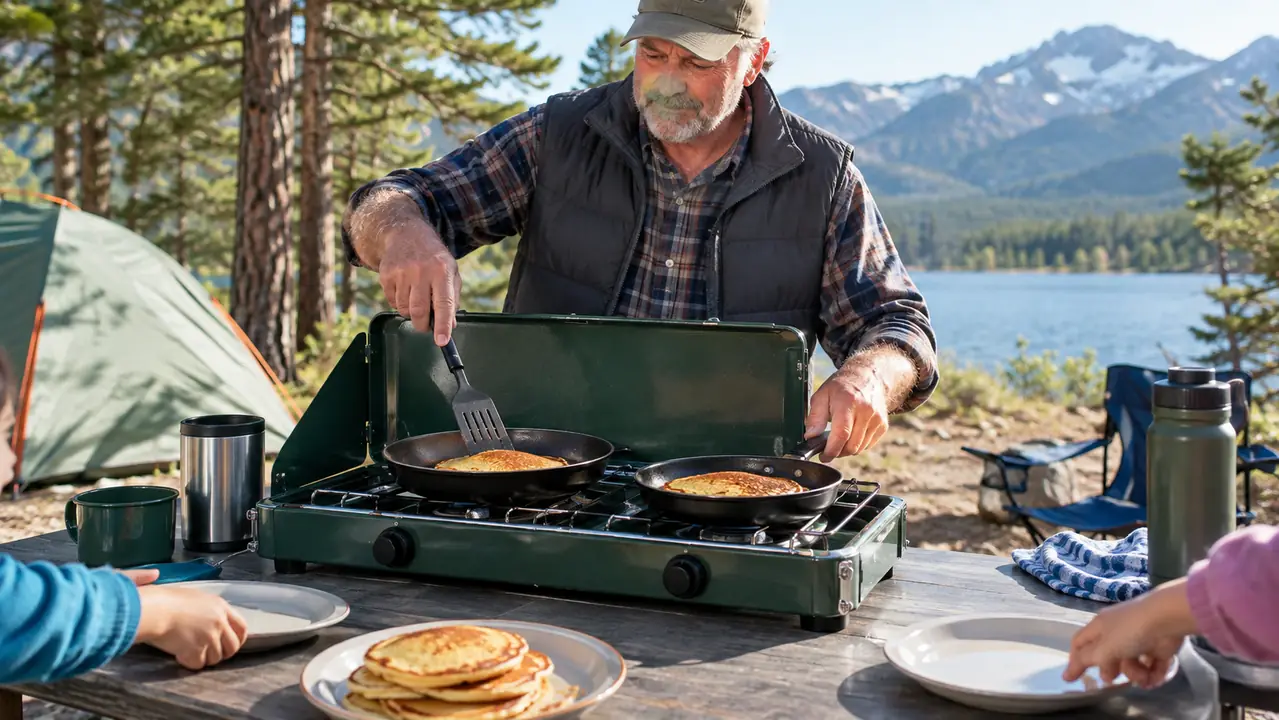
The night before a big breakfast, we do everything that can be done without a stove. I chop the onions and peppers for the eggs and put them in a zipper bag. I measure the pancake mix into a container and only add water in the morning. I cook the sausage at home and reheat it on the stove, or I form it into patties the night before so they are ready to hit the pan.
This is the step that saves the most time. In the morning, nobody wants to chop vegetables or measure flour while five kids are asking where their food is. If the prep is done, breakfast becomes a fifteen-minute job instead of a forty-five-minute one.
We also set the table the night before. Plates, cups, utensils, and the can of coffee all go on the picnic table under a towel. It sounds small, but it means the morning starts with cooking, not hunting for a spatula.
If you are driving a long distance to the campsite, do the prep at home before you load the car. Chop the vegetables, brown the sausage, and store everything in the cooler. That way the only thing you do at the campsite is heat it up. It makes the first morning of the trip feel almost easy.
Step 3: Get the stove level and preheat before anyone is awake
The Camp Chef Explorer is a two-burner stove with a flat top, and it needs to sit level or the eggs will pool to one side. I check the picnic table with a small level or just a glance. If the table is uneven, I shim the legs with a flat rock or a folded paper towel. It takes thirty seconds and it prevents a lot of frustration.
Then I turn both burners on high and let the griddle heat up for a full five minutes before any food touches it. This is the step most people skip, and it is the reason their pancakes stick. A properly preheated griddle will release food easily. A cold one will not.
I also start the coffee first. The coffee pot goes on the back burner while the griddle heats on the front. By the time the first pancake hits the griddle, the coffee is done and the kids are waking up to the smell instead of the sound of a stove hissing.
Wind is the enemy of a camp stove. If the campsite is exposed, set up a wind block with the car or a cooler. The Camp Chef has a decent wind guard, but a little extra help goes a long way. A steady flame means even cooking, and even cooking means nobody gets a burnt pancake.
Step 4: Cook in batches and use a cooler as a warming box
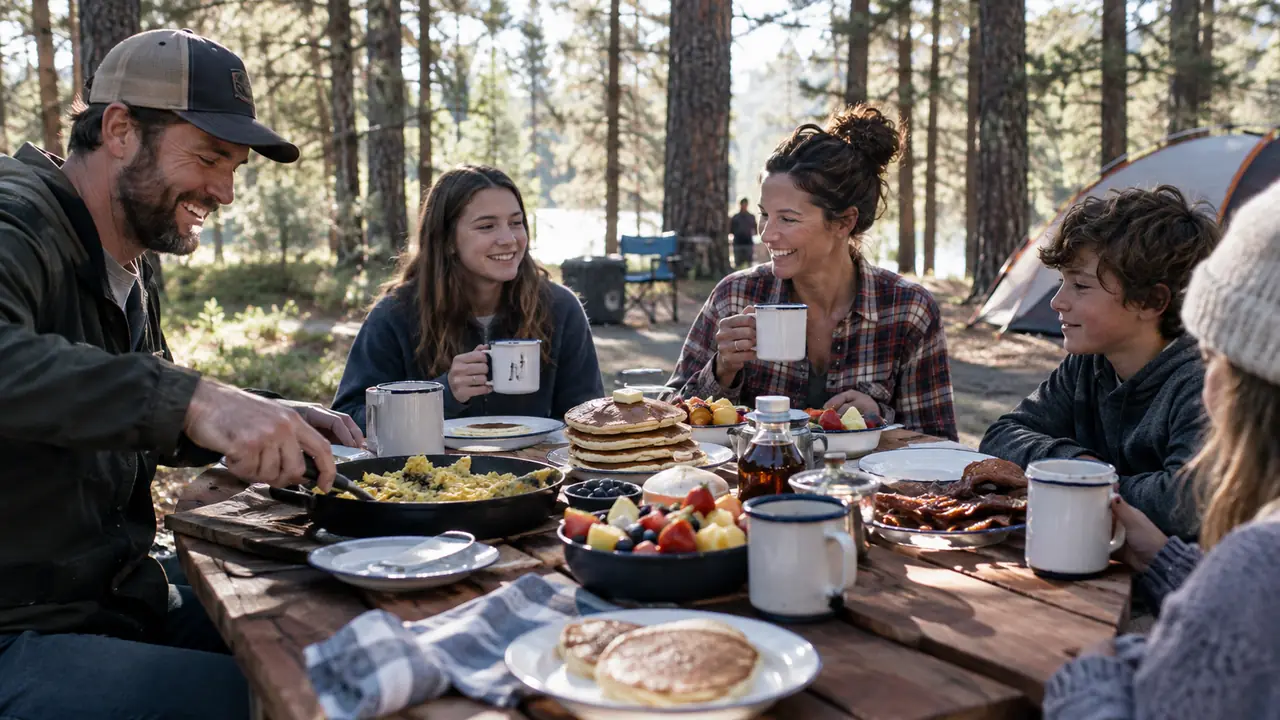
You cannot feed seven people with one skillet of eggs. You have to cook in batches, and the batches need to stay warm while the next one cooks. Our trick is a clean cooler lined with a towel. As each batch of pancakes or eggs comes off the stove, it goes into the cooler with the lid closed. The towel holds the heat, and the food stays warm for twenty minutes or more.
This changed everything for us. Before, the first person ate hot food and the last person ate lukewarm food. Now everyone eats at the same time, which means the meal is actually a family meal instead of a relay race.
If you have a second cooler, use it for the sausage or bacon. Keep the two coolers separate so the pancakes do not pick up a smoky flavor. And do not use the cooler you plan to store food in later. Use the one that is already empty.
A note on timing: start the slowest thing first. If you are making sausage patties, get them on the griddle before you start the eggs. The eggs cook in minutes, while the sausage takes longer. If you try to cook everything at the same speed, something will be waiting around and drying out.
Step 5: Clean as you go, then finish after breakfast
The fastest way to ruin a camping morning is to let the dishes pile up. I keep a wash basin with hot soapy water next to the stove. When a pan is empty, it goes straight into the basin. When the griddle is done, I scrape it with a metal spatula and wipe it with a paper towel. This keeps the cooking area usable and keeps the flies away.
After breakfast, we do a quick wash of the dishes and then head out for the day. The Camp Chef cleans up easily because the griddle and the burners are simple. I let the stove cool, wipe down the top, and stow it in the back of the Expedition. Total cleanup time is about fifteen minutes if you did the dishes as you went.
The other thing that helps is assigning one kid per meal for cleanup. The 12-year-old handles the wash basin. The teenagers rotate between drying and putting away. It is not their favorite job, but it keeps the morning moving.
One more cleanup tip: bring a dedicated dish towel and hang it over the back of a chair. It sounds small, but it keeps you from wiping your hands on your pants or a shirt that you then have to wear for the rest of the day. We hang one towel for cooking and one for drying dishes.
What Else Helps
A few extras make a big difference. A cast iron griddle that covers both burners turns the Camp Chef into one large cooking surface, which is ideal for pancakes. A long spatula and tongs keep your hands away from the heat. And a large cutting board gives you a place to work that is not the picnic table.
I also bring a small table just for the stove. The picnic table gets crowded with plates and food, and the stove takes up a lot of room. A folding camp table gives the stove its own spot, which keeps the cooking area safe and the eating area clean.
Finally, keep a backup plan for the coffee. If the stove is busy with breakfast, a French press or a pour-over setup means the coffee is not competing with the eggs for a burner. We use a simple pour-over cone and it works great.
If you are new to cooking on a camp stove, do a practice run at home in the backyard. Set up the stove, cook a full breakfast, and see how the burners behave. It is much easier to figure out the hot spots on your own lawn than it is at a crowded campground with hungry kids waiting.
One thing I stopped bringing is a separate camp toaster. It takes up space and it only makes two slices at a time. Instead, we toast bread in a dry skillet on the griddle after the pancakes are done. The bread picks up a little color and a lot of flavor, and it does not need another appliance.
The night before prep is the difference between breakfast at 8 and breakfast at 10. Do everything you can the night before, and the morning becomes a fifteen-minute job.
Ready to feed your crew in the morning?
The Camp Chef Explorer 2-Burner has the heat and the space to cook for a crowd. See today's price on Amazon and read our long-term review before you buy.
Amazon Check Today's Price on Amazon →