
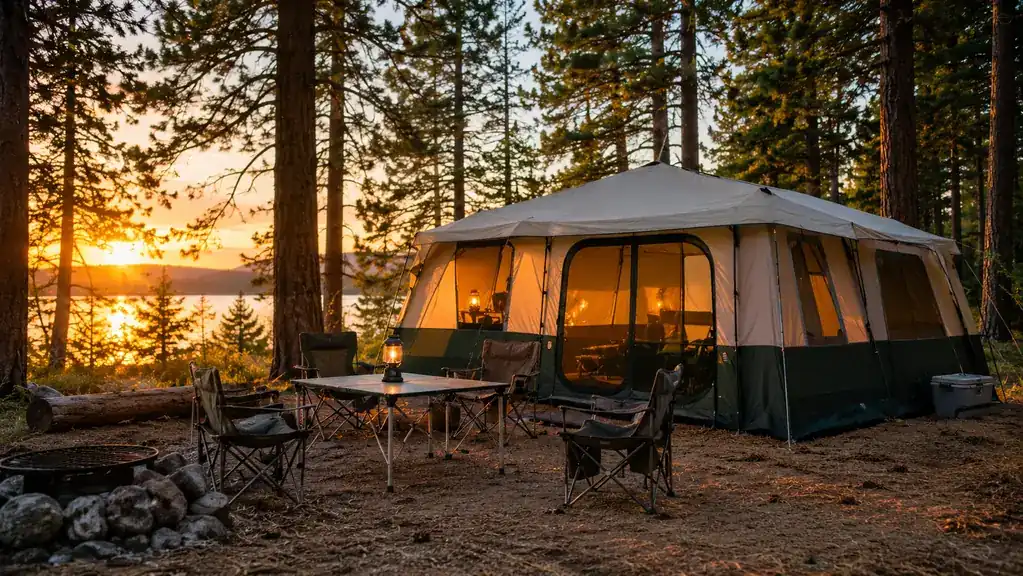
Nine people, one Ford Expedition, and one tent that has to fit all of us without anyone waking up in the middle of the night because their brother is lying across their legs. That is the real test of a family camping tent, and it is the test we ran the CORE 9 Person Instant Cabin Tent through all season: twelve trips across Utah, Idaho, and Wyoming, from a snowy May weekend at Bear Lake to a hot August stretch near Flaming Gorge. We bought it in the spring, set it up in the backyard before the first trip, and by October it had been rained on, baked in, covered in pine needles, and packed into the roof box more times than I can count. I am Brent, dad of five, and I have been doing this camping thing with my family every summer for about twelve years. I want to tell you how the Core tent actually held up, because the specs only tell you part of the story.
The Quick Verdict
The CORE 9 Person Instant Cabin Tent is the best balance of room, setup speed, and price we have found for a family our size. It is not a four-season tent and the poles are not indestructible, but for drive-up car camping with five kids, it does the job better than anything else we have owned.
Amazon Check Today's Price →Skip the 45-minute wrestling match with a tangle of poles
The CORE 9 Person Instant Cabin Tent sets up in about five minutes with two people. If you have ever stood in a campground at dusk trying to figure out which pole goes where while the kids get hangry, you already know why that matters.
Amazon Check Today's Price on Amazon →How I've Used It
A quick note on our setup: we drive a Ford Expedition with a rooftop cargo box, and the Core tent lives in that box for most of the summer. That means it gets packed and unpacked roughly a dozen times a season, which is harder on a tent than leaving it set up for a week. I mention that because the wear I describe below happened under that kind of use, the kind where you are shoving a tent into a roof box at 10 pm in the dark with a tired kid leaning on you.
The first trip was a test run in our backyard in early May. My wife Jenna and I set it up with our 12-year-old helping, and I timed us: four and a half minutes from the bag to fully standing. The poles are pre-attached to the tent body, which is the feature that makes this tent different from a traditional cabin tent. You unfold it, extend the poles, and click them into the corner pins. No threading poles through sleeves, no guessing which pole is which. The second time we set it up, we did it in the dark with headlamps and it took maybe eight minutes.
Our setup almost every trip looked like this: the tent goes up first, then the kids throw sleeping bags and duffels inside while Jenna and I deal with the camp kitchen. The tent has a room divider that splits the 14 by 9 foot floor into two spaces, and we used it every single trip. Three kids on one side, two kids plus a pack and play on the other. With the divider open, the center height is a real 6 foot 8, which matters when you are 6 foot 2 and tired of hunching in every tent you have ever owned.
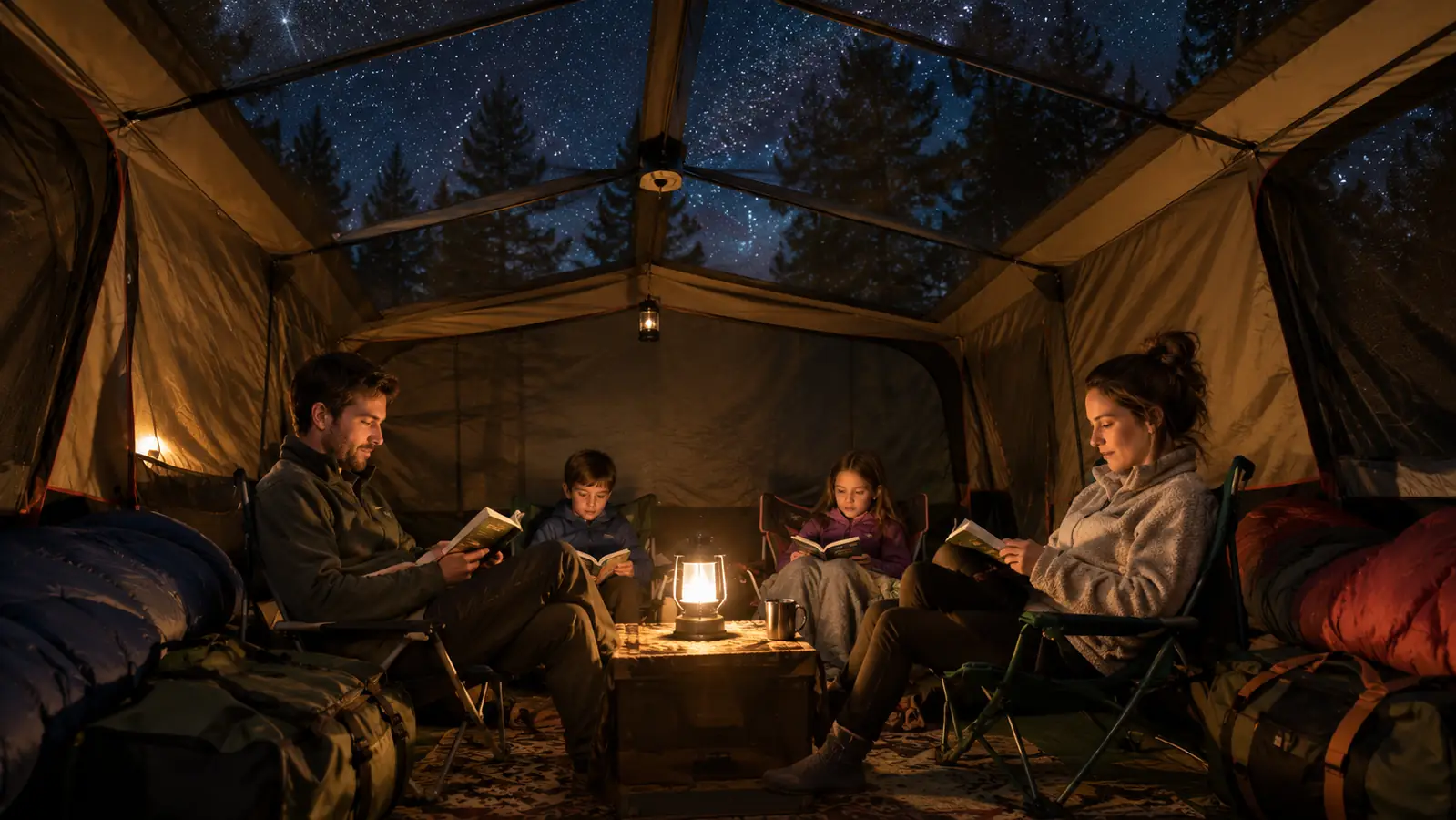
The rainfly is a separate piece that clips over the top and stakes out at the corners. On dry nights we left it off so the kids could watch the stars through the mesh ceiling. On storm nights we put it on, and I will get into exactly how it handled rain in a minute, because that is where a lot of cheap cabin tents quietly fail.
The One Feature That Changes Everything: Pre-Attached Poles
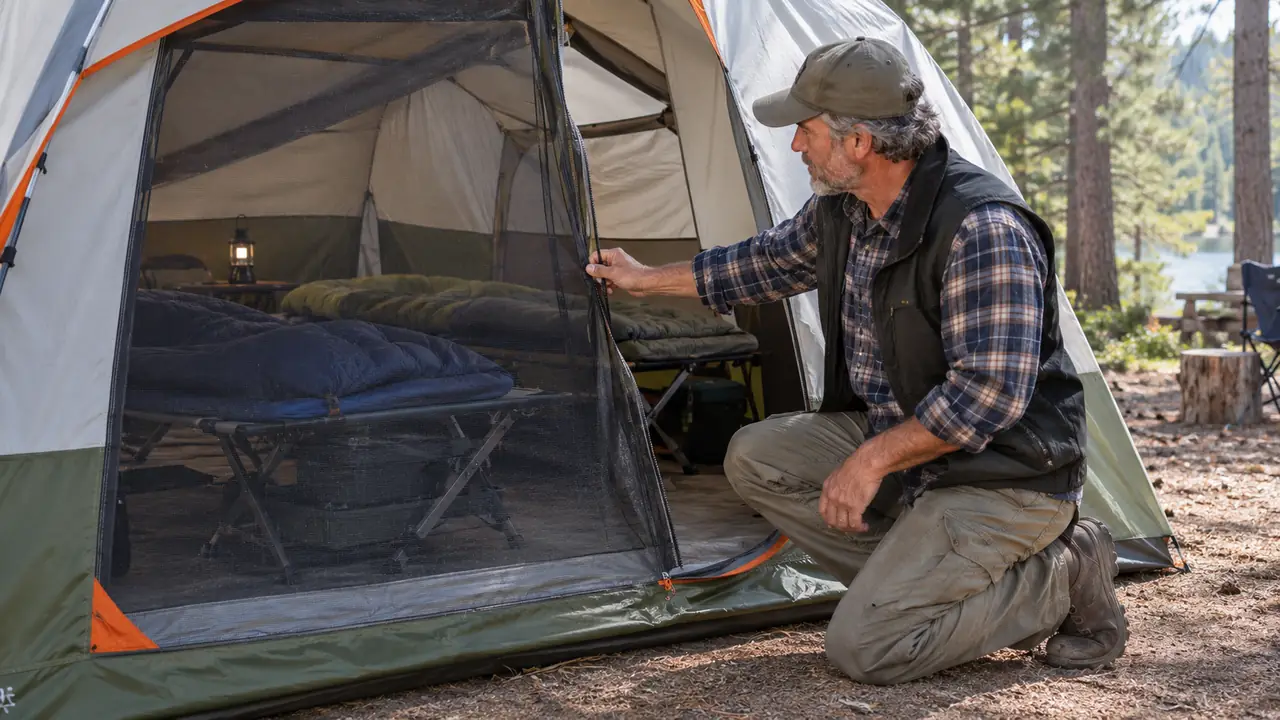
If you have ever camped with a traditional cabin tent, you know the drill: a dozen loose poles, a sleeve you have to thread them through, and a moment around pole number four where you seriously consider just sleeping in the car. The CORE 9 Person Instant Cabin Tent does away with that entirely. The poles are sewn into the tent body and fold up with it, so setup is basically unfold, extend, click, stake. The first time we set it up, I was honestly suspicious that something this fast would feel flimsy. It does not. The poles are shock-corded steel, and once they click into the corner pins, the frame is rigid enough that the tent stands on its own before you stake it down.
The tradeoff is the packed size. Because the poles stay attached, the tent does not roll into a nice compact bag the way a traditional tent does. It folds into a roughly 10 by 10 by 30 inch bundle that is heavy and awkward to carry more than a few steps. In our Ford Expedition, it rides in the rooftop cargo box and that is the only reason it works for us. If you are packing a smaller car, measure your trunk space before you buy, because this is not a tent you want to strap to a roof rack without a box.
The other thing to know about the poles is that they are the most delicate part of the whole design. The manufacturer says to extend each pole gently, one section at a time, and I believe them. The poles are not flimsy, but they are not backpacking-tent titanium either. If you let a kid grab a pole and yank it open like a fishing rod, you will bend a section. Our 8-year-old did exactly that on the third trip, and I spent ten minutes carefully bending it back into shape. It still works, but it is the one part of the tent I would call a genuine weak point. Treat the poles like the precision part they are and this tent will last. Let the kids go wild and you will be replacing it.
How It Handled Rain, Wind, and the Hot Afternoons
The big test for any tent in our family is a rainy night, because we have had trips ruined by a tent that looked fine in the store and leaked at 2 am. The Core tent has taped seams and a water-resistant coating, and we had two genuinely wet trips this season. The first was a June weekend at a state park in Idaho where it rained steadily from midnight to about 7 am. The tent held. We had the rainfly on, and the interior stayed dry, including the corners and the seams along the floor. The second was a shorter storm in Wyoming with wind gusts that had the fly flapping hard enough that I got up once to double check the stakes. Everything stayed put.
I have two honest caveats about the rain performance. First, the rainfly does not cover the entire tent. It covers the top and drapes partway down the sides, but it means the bottom few feet of the walls are exposed. If you get a driving rain with wind, you can get some dampness along the lower walls. We did not get a leak, but we did get condensation on the inside of the walls on a cold night, which is normal for a big family tent full of breathing people. Second, the floor is a bathtub floor, which means it comes up the walls a few inches. That saved us twice when water pooled at the door during a heavy storm. That is the kind of design detail you only appreciate when you are standing in the tent in your socks and your feet stay dry.
Heat is the other direction this tent gets tested. On a 90 degree afternoon in August near Flaming Gorge, the tent was hot, no way around it. The mesh ceiling and the large windows help when there is a breeze, and the two doors give you cross ventilation if you open both. But a 14 by 9 foot tent with six people in it is going to get warm no matter what you do. Our move on hot nights was to leave the rainfly off and open both doors, which brought the temperature down enough that the kids actually slept. The mesh ceiling is the best feature for this. On a clear night you can lie on your back and see the stars, and the kids still talk about that.
We set the Core tent up in four and a half minutes the first time, and a year later it is still the first thing out of the roof box on every trip.
Living With It: Storage, Setup, and the Little Things
Storage is the most underrated part of a family tent, and the Core 9 Person is better at it than most. It has seven interior pockets, which does not sound like much until you realize they are the difference between finding your headlamp at midnight and waking up the whole tent digging for it. There are also two gear lofts up near the ceiling, and we used those for the kids' flashlights, the book the 10-year-old reads every night, and a small lantern. The pockets are big enough for a phone and a wallet, and they are placed at heights where the kids can actually reach them.
The two doors are another detail I did not expect to care about. Every previous tent we owned had one door, which meant the kids all piled out the same side and the person sleeping nearest the door got trampled. The Core tent has a door on each end, which sounds minor and is actually life-changing. The teenagers use one door, the younger kids use the other, and the 4-year-old has a clear path out in the middle of the night. The doors are D-shaped, and the one on the end has a slightly larger opening, which is the one we used for hauling in the duffels and the cooler at night.
Setup details matter more than they should. The tent comes with stakes, and the stake loops are where you expect them to be. The rainfly attaches with clips rather than a sleeve, so it goes on in about two minutes. The room divider is a full wall that zips to the ceiling, not a half curtain, so when it is closed the two sides actually feel like separate rooms. The divider also has a pass-through, which the kids discovered and immediately started using to crawl between sides. That is a feature the designers probably did not intend, but the 6-year-old has declared it the best part of the tent.
The Things I Would Change
No tent is perfect, and I want to be straight with you about the things that bugged me about the Core 9 Person Instant Cabin Tent this season. First, the included stakes are adequate but not great. They are the standard thin metal stakes, and they bent a little on rocky ground in Wyoming. We replaced them with heavy duty stakes after the second trip, and I would recommend doing that on day one. Second, the carry bag is barely adequate. It is a duffel-style bag with a single strap, and once the tent is inside, it is heavy and awkward to carry. We ended up leaving it in the roof box and just grabbing the tent by the bundled body, which worked fine but is not what the bag is designed for.
Third, the setup instructions printed on the bag are minimal. The first time we set it up, we had to look up a video on our phone to figure out the order the poles should be extended. Once you have done it once, it is obvious, but the learning curve is slightly steeper than the instant branding suggests. Fourth, the tent is heavy. It is not a backpacking tent and nobody should pretend it is, but at over 30 pounds, it is a two-person carry from the car to the site. If you camp solo, this is not the tent for you.
What I Liked
- Sets up in about five minutes with the pre-attached poles
- Genuine 6 foot 8 center height, comfortable for tall adults
- Room divider creates two real rooms for kids and adults
- Two doors, seven pockets, and gear lofts make family life easier
- Handled steady rain and wind all season without a leak
- Mesh ceiling and big windows give great airflow and star views
Where It Falls Short
- Poles are the weak point, bend if a kid yanks them hard
- Carry bag is thin and awkward with the tent inside
- Included stakes bend on rocky ground, replace them early
- Packed size is large and heavy, needs a big vehicle or roof box
- Rainfly does not cover the lower walls in driving rain
Who This Is For
The CORE 9 Person Instant Cabin Tent is for families who camp out of a car, an SUV, or a minivan and who have more people than a standard 6-person tent can comfortably hold. If you have three or more kids, or two kids and a couple of friends tagging along, the extra floor space is the difference between a fun trip and a miserable one. It is also for anyone who hates the setup dance. If the thought of threading poles through sleeves makes you want to stay home, the pre-attached poles alone justify the purchase. And it is for tall people. At 6 foot 2, I have spent twelve summers hunching in tents, and the center height of this one is the first time I have been able to stand up straight in my own tent.
It is also a good fit for weekend campers who want one tent that does everything. We used it for three-night weekends, a week-long road trip, and a couple of one-nighters on the way to somewhere else. The setup speed means you can roll into a campsite at 8 pm after a long drive and be inside with the sleeping bags down by 8:20. For families, that is worth a lot.
Who Should Skip It
Skip the Core 9 Person Instant Cabin Tent if you are a backpacker, a motorcycle camper, or anyone who has to carry gear more than a hundred feet from the vehicle. This tent is big and heavy and it is not sorry about it. You do not want to carry it on your back, and you do not want to haul it up a hill. Skip it if you camp in extreme weather. This is a three-season tent, and while it handled our summer storms fine, I would not take it into a serious winter wind or heavy snow. The poles that make setup fast are not built for a foot of snow on the roof.
Skip it if you have a small car with no roof box. The packed size is the thing nobody mentions in the reviews, and it is the reason we keep ours in the rooftop cargo box. If you have a sedan or a small crossover with a full trunk, this tent will eat your entire cargo area. And skip it if you camp mostly by yourself or with one other person. A 9-person tent for two people is just extra fabric to fold. There are smaller Core tents that will serve you better.
One tent that ends the family camping argument before it starts
After a full season of family camping trips, the Core 9 Person Instant Cabin Tent is still the first thing we pack. If your family is bigger than your current tent, this is the upgrade that makes the whole season easier.
Amazon Check Today's Price on Amazon →