
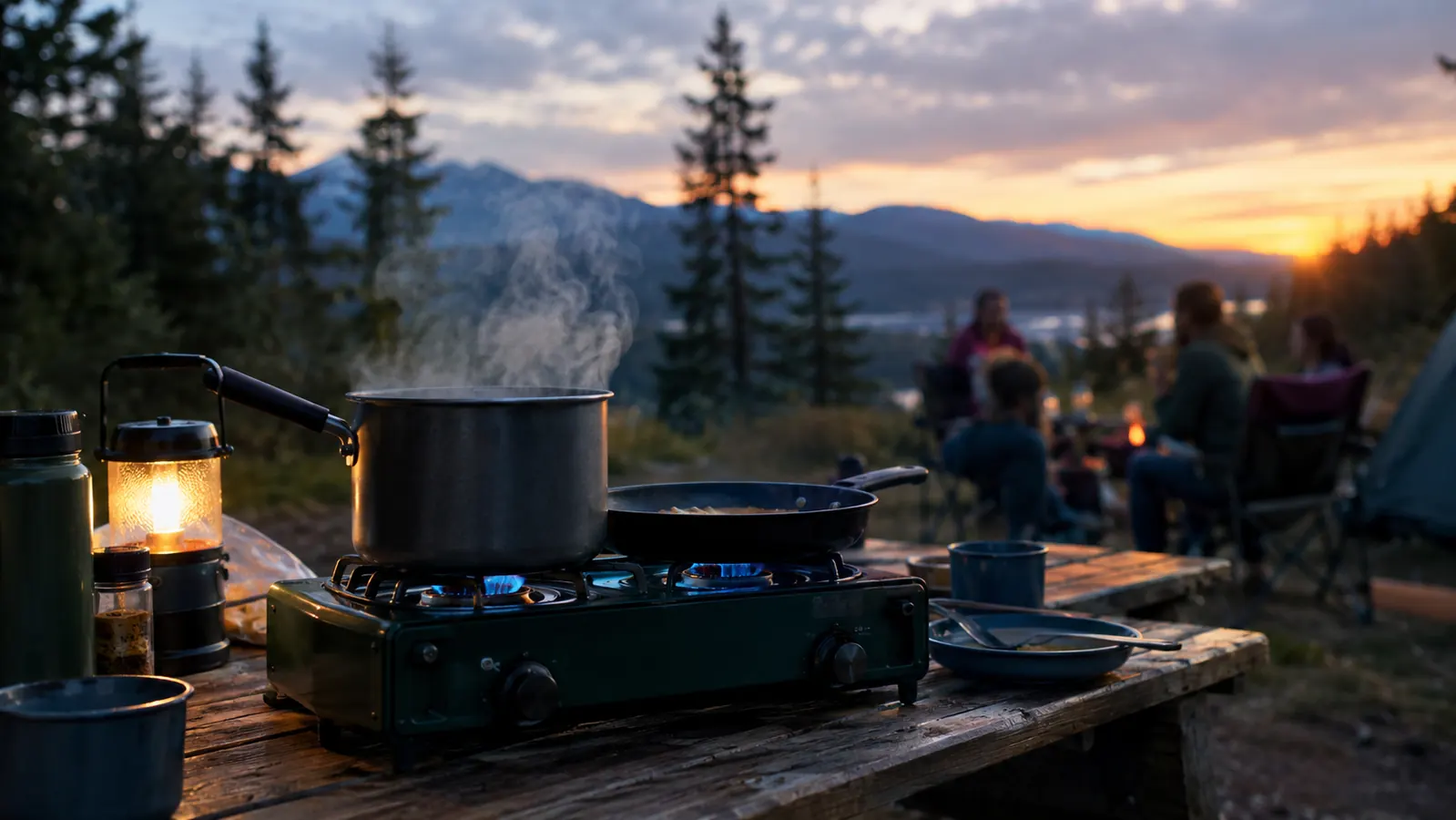
Three kids is the line where camping gear stops being a suggestion and starts being a negotiation. We crossed that line years ago, and by the time the fifth kid came along I had stopped pretending the little two-burner stove from our first trips was going to cut it. Breakfast for seven people on a stove the size of a laptop takes forever, and forever is a long time when the kids are hungry and the coffee is still in the pot. That is the honest reason I bought the Camp Chef Explorer. Not because I needed another piece of gear, and not because the marketing made it sound tough. I bought it because I was tired of cooking in shifts.
Two years and a lot of campground breakfasts later, here is what I actually think, including the parts the product page does not mention. Some of it is good, some of it is annoying, and all of it is honest.
The Quick Verdict
The Camp Chef Explorer is a big, loud, genuinely powerful stove that earns its trunk space if you cook for more than four people. It is not compact, it is not quiet, and it never pretends to be anything but a serious camp kitchen.
Amazon Check Today's Price →The stove that ended cooking in shifts at our campsite
After two summers of feeding five kids on this stove, it is the first piece of camp cooking gear I would replace without thinking. Check today's price on Amazon before you decide.
Amazon Check Today's Price on Amazon →How I've Used It
Before I get into what I think, you should know how this stove gets used at our house. We do drive-up camping, mostly at state parks and national forest campgrounds in Utah, Idaho and Wyoming, plus one long road trip every summer. The Camp Chef Explorer rides in the back of our Ford Expedition, and it comes out for breakfast and dinner almost every day we are out.
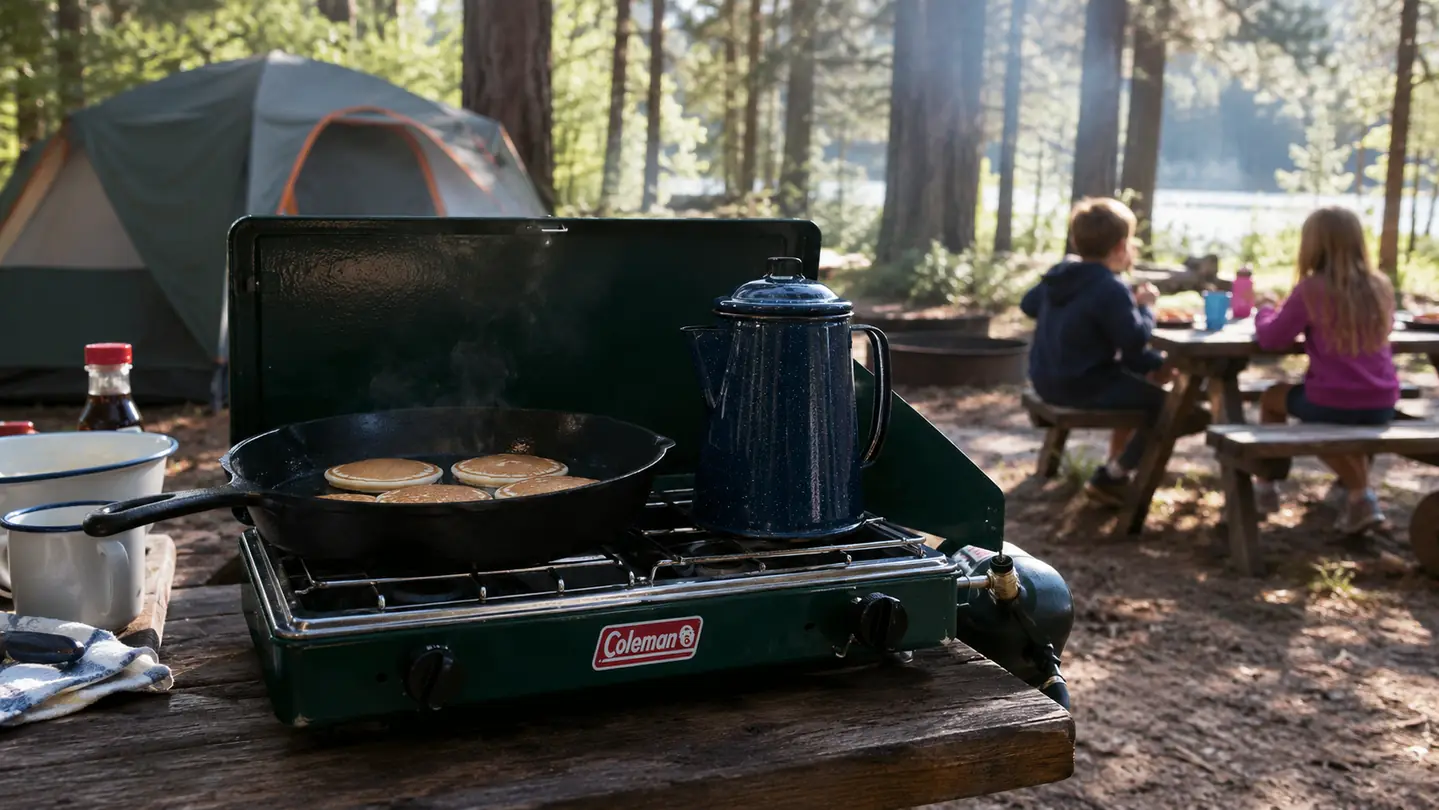
In two summers that works out to maybe 25 nights of cooking for seven people. That means big pots of water for coffee and eggs, a cast iron griddle for pancakes, and at least one night where the teenagers ate their body weight in grilled cheese. The stove has never once been run at full blast just for show. It gets run at full blast when the water needs to boil and the kids are waiting.
That context matters, because a lot of reviews read like the stove lives on a tailgate at a football game. Ours lives in the dirt next to a picnic table, gets rained on, gets loaded and unloaded from the Expedition a dozen times a year, and still has to be ready to cook for seven people at seven in the morning.
The long road trip is where the stove really earns its keep. Last summer we did a ten day loop through Wyoming, and the Explorer came out for every single meal, sometimes twice a day. On a trip like that, a stove that lights fast and boils water fast stops being gear and starts being part of the daily rhythm. You stop thinking about it, which is the highest compliment a piece of camp equipment can get.
What Nobody Tells You About the Size
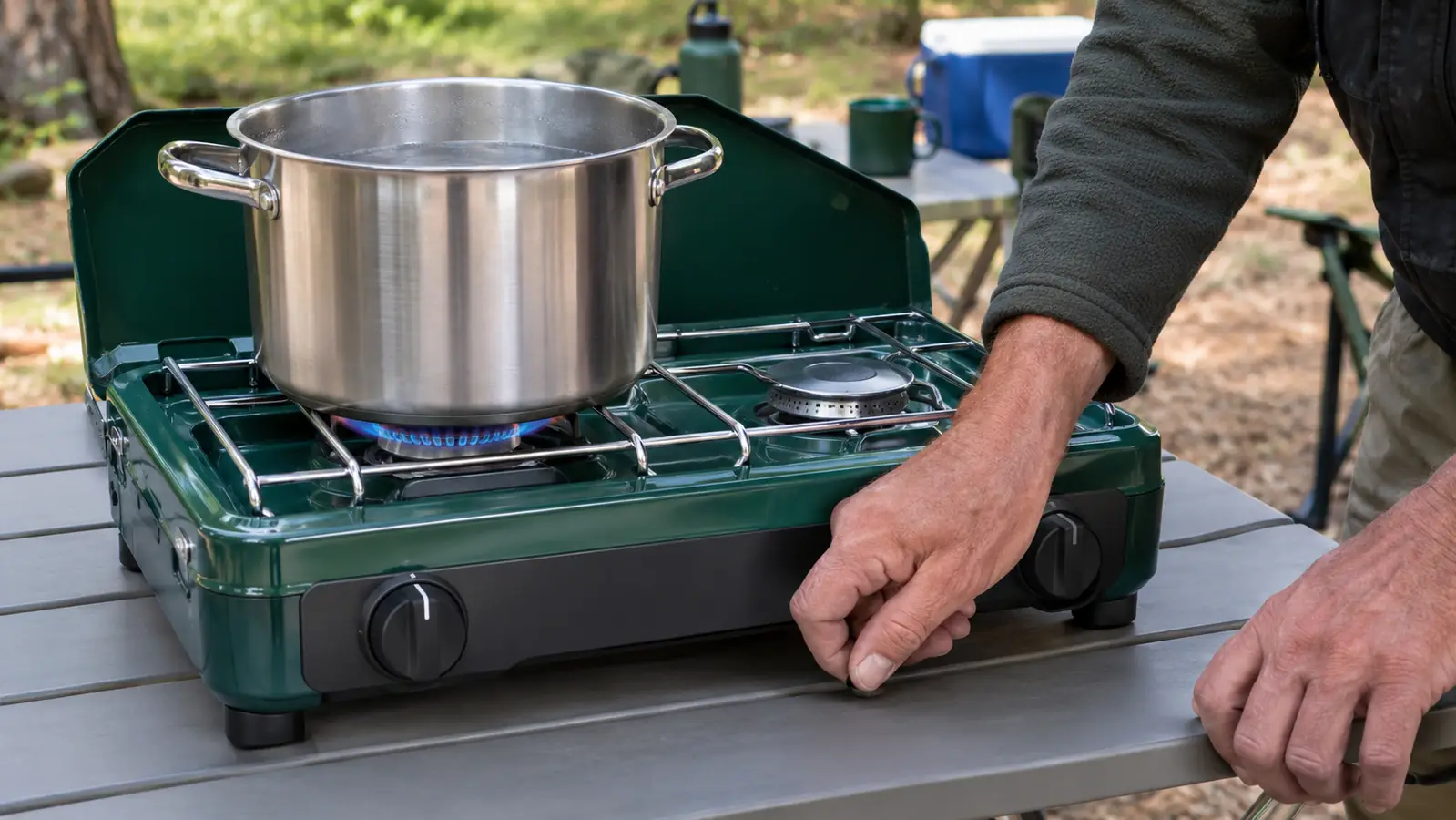
Here is the first thing the product photos hide: this stove is big. Not a little larger than the Coleman. Big enough that you will notice it every time you pack the car. The Explorer folds up into a box that takes real space in the back of the Expedition, and if you drive something smaller, you will feel it.
The tradeoff is that the cooking surface is genuinely useful. Two burners with enough room between them that you can run a 12-inch pan and a big pot at the same time without playing elbow games. On our old stove, cooking for seven meant two batches of pancakes and a lot of standing around. On this one, the pancakes, the eggs, and the water for coffee all happen at once. That is the whole argument for this stove, and it is a strong one.
The other thing nobody tells you: the legs. They fold out and lock, and they are fine on flat ground, but campground tables are rarely flat. On uneven ground the stove rocks a little, and you will want to carry a small piece of wood or a leveling block. It is a ten second fix, but it is a real thing that happens on every other trip.
One more thing about the size, and this one is about packing. The stove is heavy enough that you will not want to carry it far, and it does not balance well under one arm. We keep it in its own tote with the windscreen and a spare lighter, and it lives in the cargo area of the Expedition rather than in the rooftop box, because nobody wants to haul it up a ladder in the rain. Plan for that and it is a non-issue. Ignore it and you will be annoyed every time you load the car.
How the Burners Actually Behave
The 60,000 total BTUs number is true, and it is also a little misleading, because you will not run it there very often. At full blast this stove is loud. Not annoying loud, but loud enough that you will have to raise your voice over it, and loud enough that the first time you light it you will check to make sure nothing is wrong. It settles down once you dial it back, and most of our cooking happens at maybe half power.
What full blast is actually for is boiling water. A big pot of water for pasta or for washing dishes goes from cold to rolling in a genuinely short time, and that is the thing the kids notice. When the water boils fast, breakfast happens fast, and breakfast happening fast is the difference between a good morning and a morning where everybody stands around hungry.
Wind is the other thing people ask about. This stove handles a breeze better than our old one, mostly because the burners sit down inside the body instead of up on top. That design does real work. But it is not magic, and in a steady wind you will still want to set up with the wind at your back or rig something to block it. We keep a folding windscreen in the same tote as the stove, and we use it more often than I expected.
One thing I will say for the controls: they are simple, which is exactly what you want when you are half awake and making coffee. Two knobs, a clear low to high range, and a middle setting that is steady enough to simmer a pot of chili without babysitting it. I have used fancier stoves with finicky knobs, and I will take simple every time.
What the Kids Notice (and What They Don't)
This is the honest review part, so here is the truth: the kids do not care about BTUs, they do not care about the brand, and they would not notice the build quality if you pointed at it. What they notice is that breakfast shows up all at once instead of in waves.
When the stove is big enough to run the griddle and the pot at the same time, the pancakes come off in one batch and everybody sits down together. That sounds like a small thing until you have spent a few years watching the youngest eat while the oldest is still waiting for the first batch. The stove does not make the kids patient. It just makes the wait short enough that patience is not required.
The other thing they notice is the flame. A two-burner stove with real output puts out a flame you can see in daylight, and for whatever reason that reads as real camping to a nine-year-old in a way the little stove never did. The teenagers noticed it too, mostly because they got promoted to official water boiler and took the job seriously. If you are buying this stove for the kids, that is what you are actually buying. You are buying breakfast all at once and a flame that looks like it means business.
There is also a rhythm to it that the kids have picked up on. The oldest knows the stove needs to be checked before we leave the site, and the younger ones know to stay back while the burners are on. That is not really about the stove itself, but a bigger stove with a real flame teaches a different level of respect than a little one, and for our family that has been a good thing.
What Held Up and What Didn't
Two summers in, the honest verdict is that the Camp Chef Explorer has held up better than I expected, with a couple of small complaints.
The body is solid. The folding legs still lock tight, the burner grates have not warped, and the paint has a few scratches from riding in the back of the Expedition but nothing that matters. The regulator and hose have been fine, and the connection to a standard 20 pound propane tank is the same one every other stove uses, which means spare parts are easy to find if something ever does break.
The built-in igniter is the weak point. It works most of the time, but on damp mornings it needs a couple of tries, and I keep a lighter in the side pocket of the stove bag as a backup. That is not a dealbreaker, and honestly it is normal for a stove in this class. But it is the kind of thing the product page does not tell you, and the kind of thing that will annoy you exactly once before you learn to just keep the lighter handy.
The other small complaint is cleanup. The drip tray catches most of the mess, but a greasy pancake morning still means a little scrubbing on the burner grates. I have learned to wipe the grates down while they are still warm, because cold grease is a much bigger job. That is a habit, not a flaw, but it is worth knowing before you buy.
The one thing I would change if I could is the carry handle. There is a handle for moving it, and it works, but the stove is heavy enough that the handle digs into your hand after about twenty steps. We mostly move it from the car to the table, so it has never been a real problem, but if you are setting up at a site where the car has to stay far from the table, you will feel it.
What I Liked
- Real cooking space for big families, with room to run a large pot and a 12-inch pan at the same time
- Boils water fast, which moves breakfast and dinner along when five kids are waiting
- Solid build, standard 20 pound tank connection, and easy to find replacement parts
- Burners sit down inside the body, which helps in wind
Where It Falls Short
- Big and heavy, eats real trunk space in the Expedition
- Loud at full blast
- Rocks on uneven ground without a leveling block
- Igniter needs a backup lighter on damp mornings
The kids do not care about BTUs. They care that breakfast shows up all at once instead of in waves. That is what this stove actually buys you.
Who This Is For
Buy the Camp Chef Explorer if you cook for a crowd, and especially if that crowd is your own family. If you regularly feed five or more people at a campsite, if you are tired of cooking in shifts, or if you do one long road trip a year where the stove needs to be the reliable center of every meal, this is the stove. It is also a good fit if you already carry a 20 pound propane tank for a heater or a lantern, because the stove uses the same one.
It is for people who drive to camp. This is not a backpacking stove and it is not a tailgate toy. It is a working appliance for a family that eats real meals outdoors, and it earns its place in the car every single trip.
If you are a couple that cooks a big breakfast on weekends, this stove is probably more than you need, but it is not a waste. The extra burner space just means you can run a pan and a pot at the same time, which is nice even for two people. The real question is whether you want to give up the trunk space, and only you can answer that.
Who Should Skip It
Skip it if you camp with two people and a small pot. A smaller two-burner stove will do the same job with half the weight and a fraction of the trunk space, and you will not miss the output. Skip it if you backpack, because this stove lives in the car, not on your back. And skip it if you are looking for something compact to tuck behind the seat of a small SUV, because the Explorer is not that and it never pretends to be.
If you are on the fence, the honest advice is to think about how many people you actually feed. We bought the smaller stove first, hit the wall at three kids, and upgraded. If you are already at three or more, skip the middle step and get the bigger one.
And if you are the kind of camper who eats granola bars and calls it breakfast, this stove is overkill. There is nothing wrong with that. But a stove this size only makes sense if you actually cook, and if you actually cook for a crowd. If that is not you, save the space and the money and get something smaller.
Still the first thing I would replace if it broke
Two summers of feeding five kids and it has never let a meal down. Check today's price on Amazon and see if it fits your campsite.
Amazon Check Today's Price on Amazon →