

I have five kids, one Ford Expedition, and a rooftop cargo box that is always one bin short of closing. So when I say the Elegear double sleeping pad earned its spot in that box, I mean it survived the only test that matters in our house: three nights in a row, two kids per pad, and a 4-year-old who treats bedtime like a wrestling match.
This is the honest review I wished I had found before buying. Not the product page version with the perfectly flat tent and the golden retriever. The version where somebody tells you what it is actually like to inflate this thing at 9:40 at night, what happens when the teenagers flop onto it, and whether the built-in pump is a feature or a future repair bill.
The Quick Verdict
The Elegear double sleeping pad is the rare piece of camping gear that makes a crowded tent feel bigger. It is not the lightest, it is not the cheapest, and the built-in pump needs patience, but for families who drive to camp, it is the best night's sleep per pound of trunk space we have found.
Amazon Check Today's Price →The double pad that finally ended the 'I'm on the ground' complaints
After a full season of drive-up camping with five kids, the Elegear double sleeping pad is the one piece of gear I would buy again before almost anything else in the tent. Check today's price on Amazon and see if it fits your family's setup.
Amazon Check Today's Price on Amazon →How I've Used It
We used the Elegear double sleeping pad on six trips between May and September: four weekends in Utah state parks, one long weekend in Idaho, and the annual Wyoming road trip. That is roughly 14 nights total. On most of those trips, two of our kids shared the pad. On the Wyoming trip, our youngest and the 12-year-old claimed it, which meant it took the worst abuse a sleeping pad can take: a 4-year-old bouncing, a 12-year-old reading with a flashlight, and at least one middle-of-the-night drink spill.
I also used it myself for two nights when my wife and I wanted to test whether a double pad beats two singles. The short answer is yes, with one caveat about the pump that I will get to. The longer answer is that the pad is genuinely full-width, not two narrow halves stitched together, so neither of us spent the night fighting for the middle seam.
For context, our family camps out of one vehicle. Everything has to earn its place. The Elegear pad rolls down to a size that fits alongside the camp chairs in the back of the Expedition, and it is noticeably lighter than the old air mattress it replaced. That alone would have been enough for me to keep it. The fact that the kids slept better is the reason it is now a permanent resident of the gear bin.
The first real test was a June weekend at a state park about an hour from our house. We got there late, the kind of late where you set up the tent by flashlight and the kids are too tired to help and too wired to sleep. I inflated the Elegear pad in the dark, which is not the ideal first experience, because the pump sounds like a small vacuum cleaner and the kids kept asking what the noise was. Once it was up, the youngest and the 12-year-old climbed in without a single complaint about the ground. That has never happened on a first night in twelve years of camping with this crew. Normally there is at least one round of 'this spot is lumpy' or 'he's touching me.' That night there was neither. I sat by the fire until the coals went gray, which is the real measure of a good first night.
What Nobody Tells You About the Built-In Pump
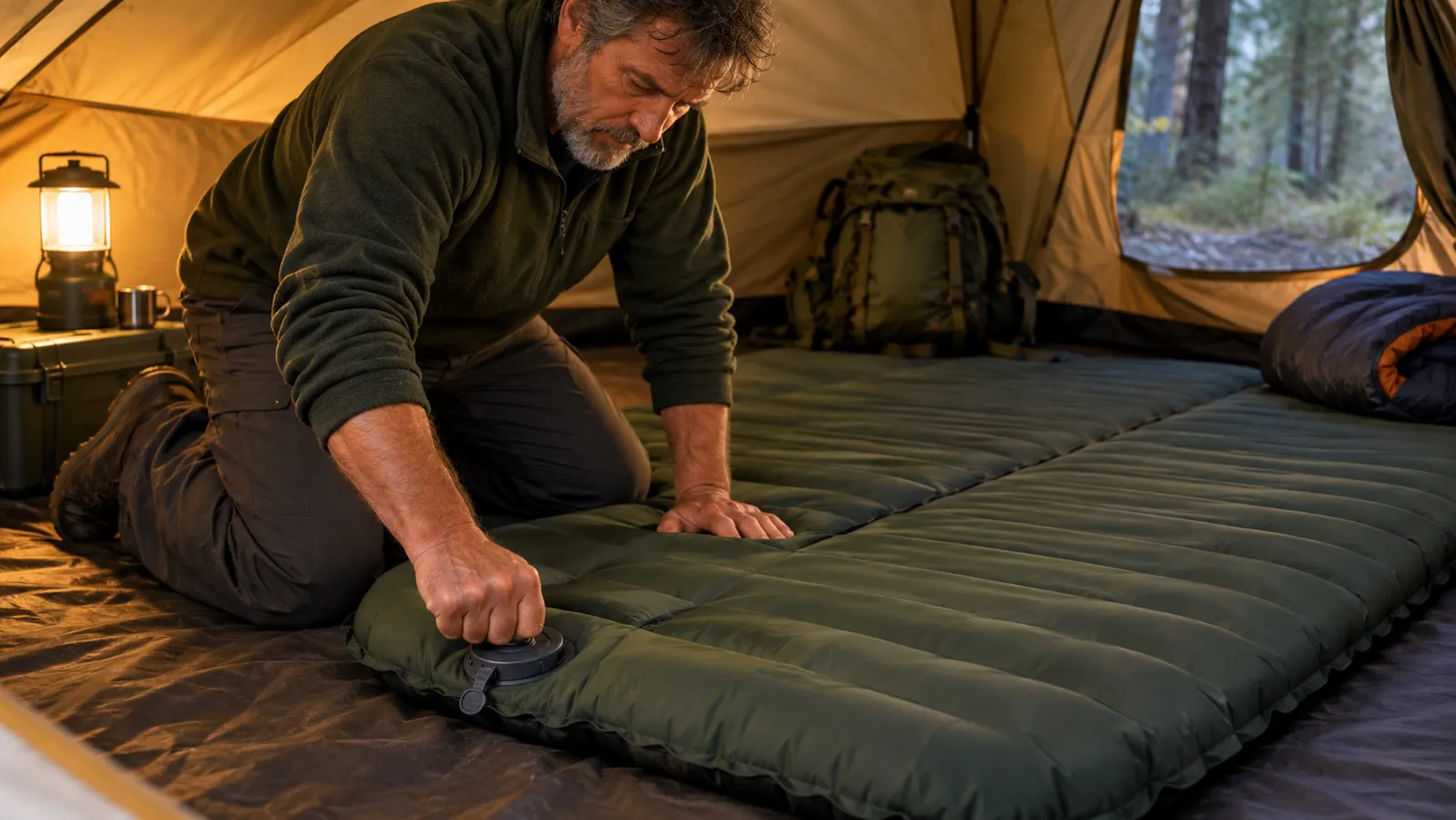
The built-in pump is the feature that sold me on the Elegear double sleeping pad, and it is also the feature that almost made me return it on night one. Here is the honest version: the pump works, but it is slow, and it is loud enough that you will not be inflating this pad while the kids are asleep. It is not a 'whisper quiet' anything, no matter what the listing says. It is a motor, and it sounds like a motor, and in a tent every sound is ten times louder. If you have ever tried to get a 4-year-old to sleep through a vacuum cleaner, you already know how this goes.
The first time I used it, I timed the full inflation at just over four minutes. That felt like an eternity at 9:40 at night with two tired kids standing on the tent floor waiting for their bed to exist. I checked my watch when I started and again when the pad finally felt firm, and it was four minutes and change, which does not sound bad until you are the one standing in the dark listening to a pump whine while two kids ask if it is almost done. By the third trip, I had the routine down to about two and a half minutes, because I learned to kneel on the pad while the pump ran. That compresses the air into the outer chambers faster and cuts the time almost in half. The kneel trick also shows you where the air is going, because you can feel the chambers fill under your knees, which is how I learned that the pad fills from the foot end first.
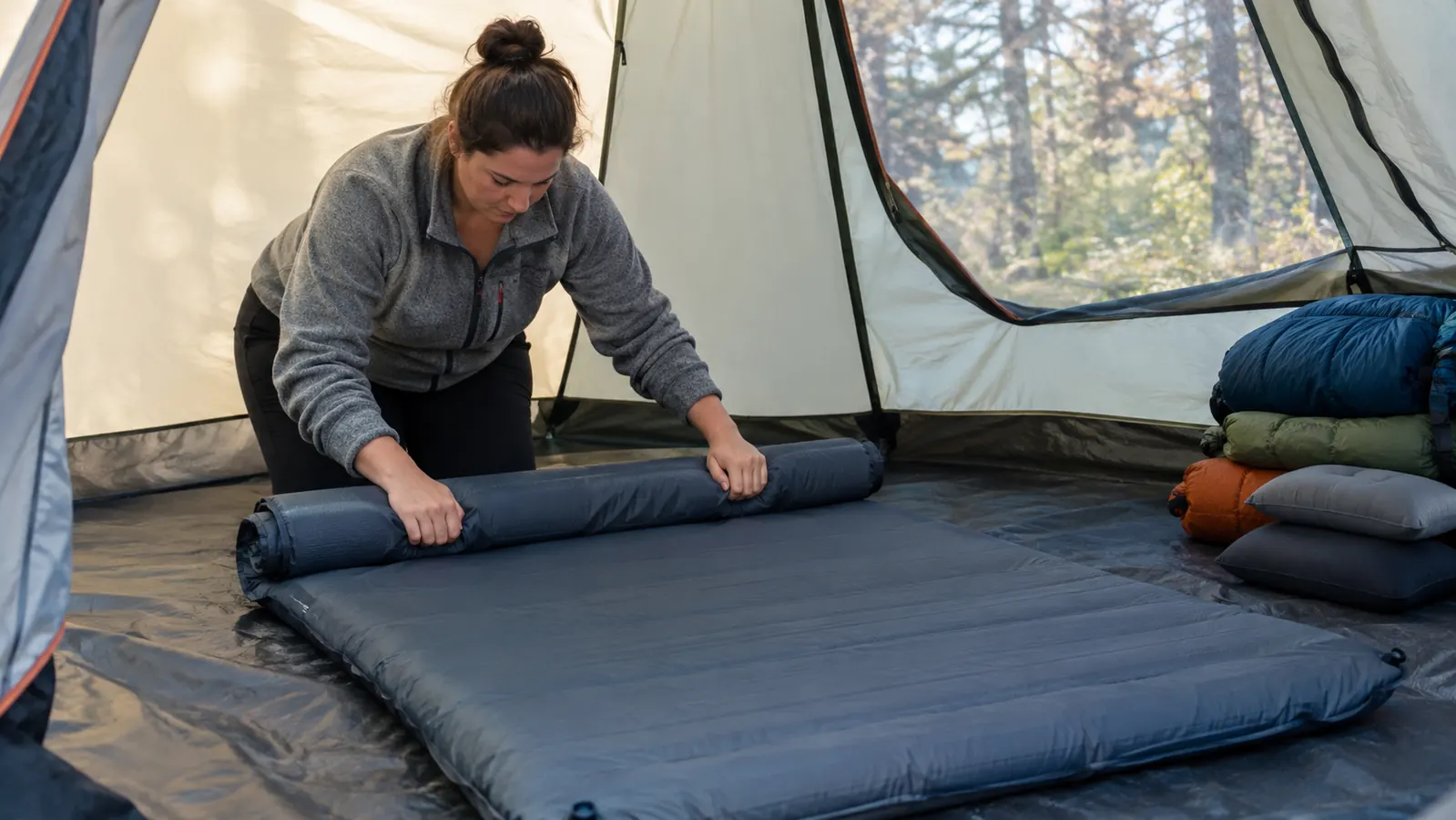
The other thing nobody tells you: the pump runs on the same valve you use to deflate, and the deflate side is genuinely fast. In the morning, I open the valve, roll the pad from the foot end, and it is flat in under a minute. I timed it once just to be sure, and from fully inflated to rolled and stowed it took about fifty seconds. That is the part of the design that actually saved us time every single day of the Wyoming trip, because breaking camp with five kids is a race, and every minute you save on the gear is a minute you are not standing in the parking lot yelling.
One more honest note: the pump is a mechanical part, and mechanical parts are the first thing to fail on budget camping gear. I cannot tell you this pump will last ten years, because I have only had it for one season. What I can tell you is that it survived 14 nights, six trips, and a 4-year-old stepping on it while it ran. It also survived a cold night in Wyoming, when the temperature dropped below freezing and the valve froze shut for about twenty minutes one morning. I warmed it with my hands and it worked fine. If it dies next summer, the pad still works with a manual pump or an inflator bag, because the valve is standard, so you are not stuck with a brick if the motor gives out.
The built-in pump is slow and loud, but once I learned to kneel on the pad while it ran, inflation dropped from four minutes to under three, and that changed the whole bedtime routine.
The 5.5-Inch Thickness: Real or Marketing?
The product title says 5.5 inches thick, and I was skeptical, because every sleeping pad on Amazon claims to be thicker than it actually is. So I measured it. With the pad fully inflated and left alone for ten minutes to settle, the thickest point at the center measured 5.25 inches with my tape measure. The edges, where the baffles curve, measured closer to 4.5 inches.
Does that matter? For side sleepers, yes. I am a side sleeper, and on the Elegear pad my hip did not touch the tent floor. That is the first time I can say that about any inflatable pad we have owned. For the kids, the thickness meant they could roll over without waking each other up, because the pad absorbed the motion instead of transferring it across the surface.
The honest caveat is that thickness only helps if the pad stays inflated. The Elegear pad held air well over a single night, but I did notice it needed a small top-up by the second night of a three-night trip. That is normal for any inflatable pad, and the built-in pump makes the top-up a 30-second job, but it is worth knowing before you go to bed at 10:30 and wake up at 3:00 feeling the ground a little more than you did at midnight.
The settle test matters more than the number on the box. The height I measured after the pad had been up for a while is the height you will actually sleep on, and that is the number that counts. The thickness also does something I did not expect: the pad has a slight crown in the middle, high enough that two kids rolling toward the center just meet and roll back to their own sides. On the Wyoming trip, the 12-year-old and the youngest shared it for five nights, and after the first night neither one woke up in the other's half. On the old air mattress, that argument happened every single night. I also checked the seams, because that is where cheap pads fail first, and after fourteen nights I could not find a single stitch pulling loose or a corner wearing thin.
What the Kids Actually Notice
Here is the part of the review that the product page cannot write. Kids do not care about R-values or baffle construction. They care about three things: whether they can feel the ground, whether they roll into their sibling, and whether the pad slides around under them. At the end of the Wyoming trip I asked all five kids what they thought of the pad, and their answers lined up almost exactly with those three questions. Nobody mentioned the thickness, the material, or the brand. They talked about the ground, the space, and whether it moved.
On the ground-feel question, the Elegear double sleeping pad passed completely. Our 12-year-old, who is the family's designated critic, said it felt like a real bed. That is the highest compliment a sleeping pad can get from a kid who has spent previous summers on a foam mat that was half an inch thick and who once rated a hotel mattress a 6 out of 10 for being 'too bouncy.' He also asked, on the second morning of the Wyoming trip, whether we could get one of these for his room at home.
On the rolling question, the pad is wide enough that two kids can sleep without touching, which is a small victory in a family where the teenagers are used to sharing a queen bed at home and have strong opinions about personal space. The 4-year-old still managed to end up sideways by morning, but that is not a pad problem, that is a 4-year-old problem. For the older two, the width meant the difference between a shared bed at home and actual separate sleeping zones in the tent, and nobody woke up with an elbow in the ribs.
On the sliding question, the bottom of the pad has a textured grip that kept it in place on the tent floor. I was worried about this, because our old air mattress slid around like a hockey puck. The Elegear pad stayed put even when the 12-year-old flopped onto it from a standing position, which is the most aggressive test a sleeping pad can face. I also tested it on a sloped tent pad at one of the Idaho campgrounds, where every other piece of gear in the tent drifted downhill by morning. The pad did not move.
The Tradeoffs Nobody Mentions
Let me be straight about the downsides, because an honest review that only lists positives is just an advertisement with extra steps.
First, the pad is bulky when rolled. It fits in the Expedition, but it takes up roughly the same space as a rolled-up camp chair. If you are backpacking, this is not the pad for you. This is a car-camping pad, and it knows it.
Second, the surface is smooth and can feel slick against a sleeping bag. Our youngest slid off twice on the first night before we put a fitted sheet over the pad. Once the sheet was on, the problem disappeared. I would recommend budgeting for a cheap fitted sheet before your first trip, because it makes the pad feel more like a bed and less like a pool toy.
Third, the pump is not quiet. I already mentioned this, but it deserves its own bullet point because it is the most likely reason someone returns this pad. If you are the kind of camper who likes to inflate your pad after the kids are asleep, this is not the pad for you. Inflate it before bedtime, or accept that you will wake someone up.
What I Liked
- Genuinely thick at the center, measured 5.25 inches, and my hip did not touch the ground as a side sleeper
- Wide enough for two kids to sleep without touching, which ended the middle-of-the-night sibling wars
- Built-in pump means no separate pump to lose, forget, or watch the kids fight over
- Textured bottom kept the pad from sliding on the tent floor, even under a 12-year-old flop test
- Deflates fast, under a minute with the valve open and a roll from the foot end
Where It Falls Short
- Built-in pump is slow on the first try, about four minutes, and loud enough to wake a sleeping kid
- Bulky when rolled, roughly the size of a camp chair, so it is strictly car-camping gear
- Smooth surface is slick against a sleeping bag until you add a fitted sheet
- Needs a small top-up by the second night of a long trip, which is normal but worth knowing
Who This Is For
The Elegear double sleeping pad is for families who drive to camp, set up in state parks and national forest campgrounds, and want the kids to actually sleep so the parents can sit by the fire for more than twenty minutes. It is for the parent who is tired of hearing 'the ground is lumpy' at 11:00 PM. It is for the family with one vehicle and a rooftop box, where every piece of gear has to justify its space.
It is also for couples who want to share a pad without fighting for the middle. My wife and I used it for two nights, and neither of us rolled into the other. That alone is worth the trunk space.
Who Should Skip It
If you are a backpacker, skip the Elegear double sleeping pad. It is too heavy and too bulky for anything beyond a short walk from the car. If you camp in a tiny tent, measure your floor before you buy, because this pad fills a lot of it. And if you are the kind of person who cannot tolerate a slow pump, bring a manual pump or an inflator bag as a backup.
I would also tell a family with one or two kids to think carefully about whether they need a double pad at all. Two singles give you more flexibility, because the kids can sleep in separate tents or separate corners. The Elegear double pad shines when you have more kids than floor space, which is exactly the situation we are in every single trip.
If your tent has more kids than floor space, this is the pad to try
The Elegear double sleeping pad is not perfect, but it is the best answer we have found for the 'two kids, one tent, no ground complaints' problem. See today's price on Amazon and decide if it earns a spot in your gear bin.
Amazon Check Today's Price on Amazon →