
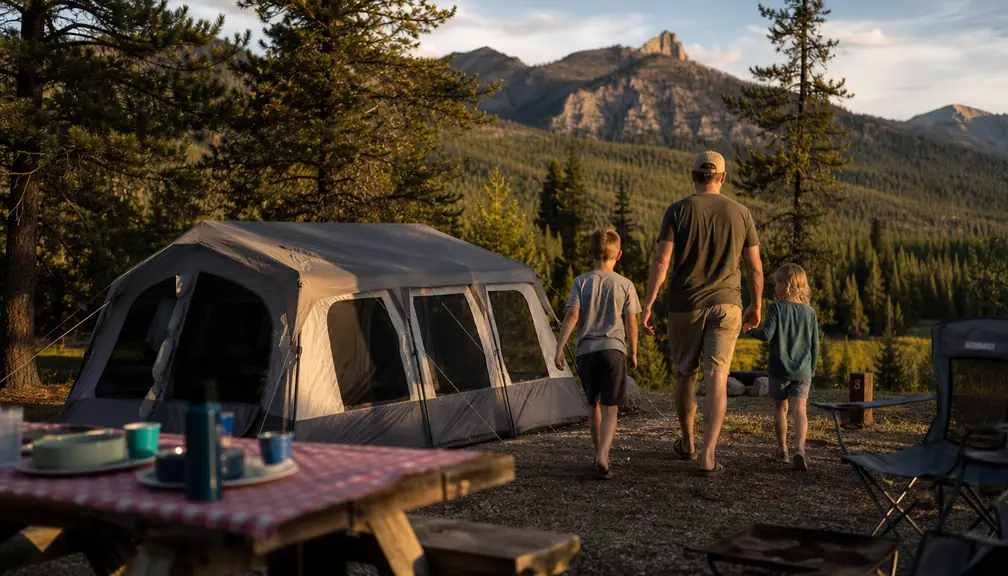
I'll be honest: the CORE 9 Person Instant Cabin Tent sold me in a parking lot. I popped it up in about four minutes on the grass beside the store, walked through it with a guy from the camping aisle, and decided this was the tent for five kids and two tired parents. That was in May. By August we had slept in it on four separate trips, our youngest had used it as a fort at least six times, and I had a much clearer picture of what that parking lot demo never showed me.
This is the version I wish someone had handed me before I bought it. Not the product page, and not the store demo. The version where I tell you what held up, what annoyed me, what the kids actually use, and which claims you should take with a grain of salt. The Amazon page shows more than seven thousand reviews and a 4.6 average, which is why I gave it a long look in the first place. If you are shopping for a tent to fit three or more kids, this is the honest version.
The Quick Verdict
A fast-pitching, genuinely roomy cabin tent that gives a big family a kids' side and an adult side. Treat '9 person' as five to six people, accept the flappy walls in wind, and this is one of the better family buys we have made.
Amazon Check Today's Price →The Version the Product Page Won't Give You
Four trips, five kids, one rainy night in Utah, one windy night in Wyoming. Here is what held up, what did not, and what I would still buy tomorrow.
Amazon Check Today's Price on Amazon →How I've Used It
It is a 14 by 9 cabin tent with a center divider, and I am not going to pretend this is a lab test. I bought it for one reason: to fit our family. Our crew is me, my wife Jenna, and five kids from age 4 to 15. We drive one Ford Expedition with a rooftop cargo box, and we camp in state parks and national forest campgrounds across Utah, Idaho, and Wyoming. That means we do not backpack this tent anywhere. We pull up, we set up, we stay two or three nights, and we pack out.
This review is built on four trips over one summer. A Memorial Day weekend at a Utah state park where it rained steadily Friday night. A hot July stretch in Idaho where the afternoon sun cooked the campsite. An August trip to Wyoming where the wind came up hard after dark. And one long weekend of mostly perfect weather. That mix gave me a fair idea of what the tent does well and where it falls short.
What 'Instant' Really Means
The box says instant. The marketing says 60 seconds. The truth is somewhere between 'faster than any pole tent I have owned' and 'do not attempt this alone on the first try.' The poles are pre-attached and the whole thing unfolds like an umbrella, which is genuinely clever. My first solo setup took about 12 minutes because I had to learn the order of operations. By trip three, my wife and I could go from trunk to standing tent in under five minutes, with the kids mostly in the way. That is a real advantage, not a slogan.
What nobody tells you: you should buy the separate footprint. CORE sells one, and it is worth adding to the order. The tent floor is fine on its own, but the ground cloth keeps the floor clean and gives you a dry place to kneel while you snap the poles into their clips. The stakes that come in the bag are another story. They work in soft, forgiving ground. In the hard, dry soil we camp on, I replaced them with heavier ones after the first trip.
One more thing the demo skips. The folded tent is a long, awkward bundle, close to four feet, and it does not lie flat in the back of the Expedition. It goes diagonally across the cargo area or, on our trips, strapped to the rooftop box. Plan for that before you load the car.
The Room Divider: What Nobody Tells You
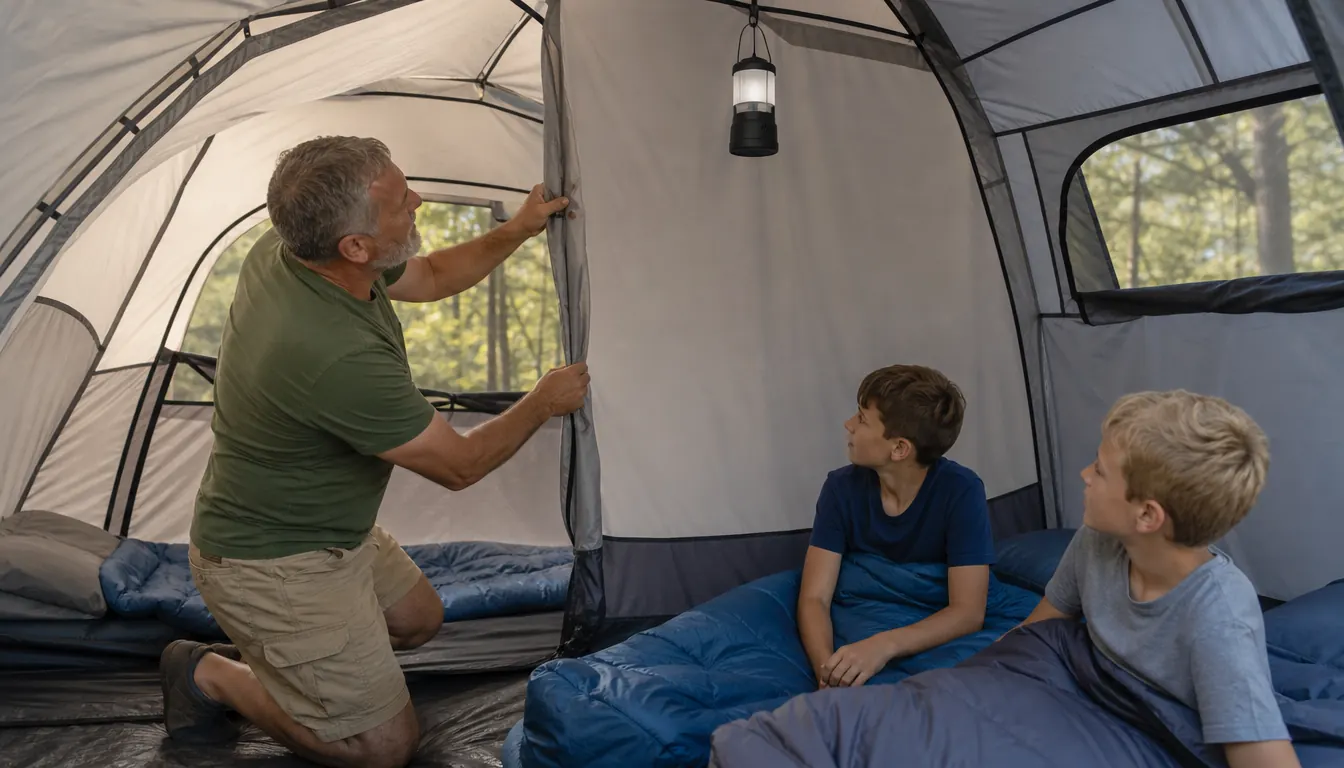
The divider wall clips to the ceiling and splits the 14 by 9 into two rooms. That sounds like the answer to every family camping problem. It is half the answer. The divider does not reach the floor. There is a gap of maybe six inches at the bottom, which is good for airflow and useless for sound. You hear every snore, every four-year-old night whisper, and every teenager complaining about the other teenager. What the divider does well is give the little kids a visible line. Our youngest stays on her side at night because she can see the curtain. That alone was worth the purchase.
The other thing nobody tells you: the divider changes how light moves through the tent. We hung a battery lantern from the loop in the main room, and the divider threw most of the back room into shadow. The fix was a second small lantern in the back room. It is a minor thing, but it is the kind of detail you only learn by actually sleeping in the tent.
Rain, Wind, and the 2 AM Test
Friday night of the Memorial Day trip, it rained. Not a drizzle. A steady mountain rain that started after dark and lasted most of the night. The tent has taped seams and a coated fly, and the verdict is that it stayed dry. I walked the interior at six in the morning in my socks, feeling the floor at the corners and under the windows. Dry. The window covers zip shut and they held. I will not pretend the fly covers the whole tent. It does not. The fly sits over the top, the upper walls are mesh, and the lower walls are solid polyester. In steady rain it worked. If I were on an exposed ridge in a sideways downpour, I would want a full-coverage fly. That is not what this tent is for.
The wind test was less flattering. On the Wyoming trip, gusts came up after midnight and the walls flapped hard enough to wake the 12-year-old. The tent is tall and the fabric is a fairly light 70 denier, so it moves. It did not collapse, and the frame held, but it was loud. Guy lines matter. I staked every loop and the noise dropped a lot. If you camp where wind is normal, bring extra stakes and use every guy point. One more honest note: with five people breathing all night, the inside of the fly had moisture in the morning on the cool trips. That is normal for any tent. Keep the interior mesh vents open on cool nights or the moisture collects on the divider.
What the Kids Actually Notice
This is the section the title promised. After four trips, here is what the kids actually care about.
The ceiling height. The tent is tall enough for me to stand up in, and the kids treat that like a big deal. The teenagers stand in the center just because they can. That sounds silly until you have spent a rainy afternoon inside a tent with five kids. Standing height changes the whole trip.
The storage pockets. CORE put pockets all over the walls. The kids claimed them in the first hour. Every headlamp, water bottle, and pocket rock found a home. It kept the floor clear, which meant nobody stepped on anybody else's stuff in the dark.
The back room. With the divider up, the kids decided the back room was theirs and the front room was the adult room. They policed it themselves. I did not have to ask. The tent basically created a kids zone and an adult zone, and for a family this size, that is the single biggest win on this list.
What they did not notice: the brand name, the cost, or any feature I spent an hour reading about before buying. They noticed whether they could stand up, whether they had a pocket for their stuff, and whether their side felt like theirs.
Sleeping Arrangements: The Real Math
Here is where the 9 person claim gets interesting. The floor is 14 by 9, which is about 126 square feet. That is a lot of floor. But you are not sleeping nine adults on it comfortably, because nobody camps with zero gear, and because the divider hangs down and takes a little visual space even when it is clipped up. Our setup: the back room got three kids on sleeping pads, and the front room got the other two kids plus Jenna and me on a big air mattress. That worked. We had room for a duffel at the foot of the mattress, and the kids kept their shoes in the corner by the door. If we had tried to put all seven of us plus cots and a cooler inside, we would have been tripping over each other all weekend.
Cots are worth a warning. The tent is tall enough for cots, which is great, but cots take up more floor than pads and they make each room feel narrower. If you plan to use cots, drop your realistic capacity by one person per room. For pads, the floor is genuinely comfortable, and the tent has enough headroom that even the grumpiest kid can sit up fully in the morning without hitting the ceiling.
The Small Details That Matter at 11 PM
Two or three details deserve their own paragraph, because they all surface late at night. The zippers are loud. That sounds like a nitpick until you are the parent trying to sneak out for a bathroom run at midnight without waking the 4-year-old. The main door zipper has a solid feel and never jammed on us, but it is not quiet. Pull it slowly and you can keep the noise down.
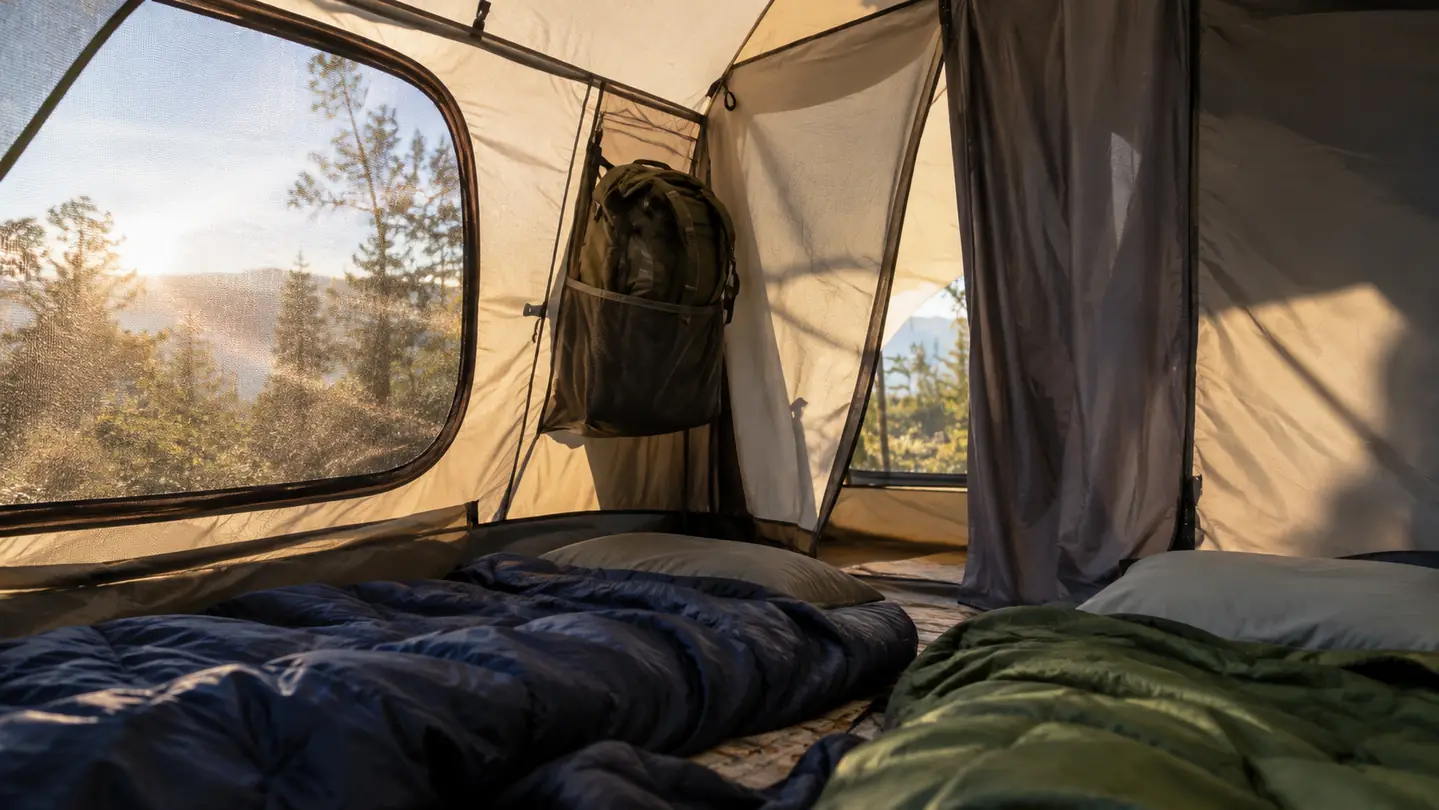
The ground vent is a real feature. CORE put an adjustable vent low in the wall, and on warm nights we cracked it open. It pulls cooler air in from ground level, and it made a noticeable difference at a July campsite that was still 85 degrees at nine o'clock. We camp without air conditioning by choice, and that vent, plus the mesh windows, kept the tent from turning into an oven.
There is also a covered electrical port on the wall. At the one park where we had a power site, we ran a phone charging cable through it. Small thing, but it meant we did not have to keep the door cracked for a cord.
Pack-Up, Storage, and the Trunk Math
Setup is fast. Pack-up is the trade. The pre-attached poles that make setup instant also make the tent floppy when you try to fold it. You have to collapse the poles in the right order, then fold the fabric into a shape that fits the bag. The first time we packed it, two adults and a teenager spent twenty minutes fighting it, and it still looked like a burrito that lost the fight. By the end of the summer I could do it alone in about ten minutes, as long as the tent was dry.
If the tent is wet, you have a real problem. The bag is not generous. Wet fabric is thicker and bulkier, and getting it back in the bag takes patience. Our habit is to air the tent out on the line at home for a day before folding it. If you are doing a one-night stop and moving on, budget time for the pack-up or you will be cranky.
Storage is simple. The folded tent is roughly the size of a large duffel bag, close to four feet long. It lives in the garage between trips and rides in the rooftop cargo box on the way to camp. It is not a tent you keep in the car for spontaneous stops unless you have a big cargo area.
What I Liked
- Fast, real setup: under five minutes for two people once you learn the order
- Stand-up ceiling height that both kids and adults notice right away
- The divider creates a kids' side and an adult side, worth more than any spec
- Stayed dry through a steady mountain rain with taped seams and zippered window covers
- Wall pockets everywhere keep headlamps and water bottles off the floor
- Genuinely roomy 14 by 9 floor for a family of five to seven
Where It Falls Short
- '9 person' is marketing math. Comfortable for five to six with gear, not nine
- Included stakes are light for the hard, dry soil most western campgrounds have
- Pack-up is fiddly, and the bag is tight when the tent is wet
- Tall walls catch wind and flap loudly unless every guy point is staked
- The divider blocks light but not sound
- The rainfly does not cover the full tent, so exposed ridge camping is out
Four trips, one steady mountain rain, five kids, and zero leaks. What I did not expect was the divider creating a kids' side and an adult side without a single argument.
Who This Is For
This tent is for the family that drives to a campsite, sets up for a long weekend, and wants everyone in one tent without actually being in one room. If you have three or more kids, the divider and the standing height are worth a lot. It is also for people who hate pole tents. The instant setup is real. If you have ever spent forty-five minutes threading poles through sleeves while a toddler wanders toward the fire pit, this tent will feel like a luxury. And it is for people who camp in normal weather. It is a fair-weather-to-light-rain tent. For the majority of state park weekends, that is exactly what you need.
Who Should Skip It
Skip it if you are a backpacker. This tent weighs just over twenty pounds and packs to the size of a small kayak paddle. It is not going on your back. Skip it if you camp in serious wind or expect heavy storms. The fly does not cover the full tent, and the tall walls are not built for exposed ridgelines. Skip it if you genuinely need to sleep nine people. You can fit nine sleeping bags on the floor in a pinch, but you will not fit nine people and their gear, and nobody will sleep well. Treat it as a generous five-to-six-person tent and you will be happy.
The Bottom Line
After four trips and one summer, the CORE 9 Person Instant Cabin Tent is staying in our garage. It is not perfect. The 9 person claim is generous, the included stakes are weak, and pack-up will test your patience. But it sets up fast, keeps a family of seven dry in a normal mountain rain, and gives five kids enough room to actually sleep. For what we need, that is the whole job. Buy it if you drive to a campsite with a car full of kids and want a tent that makes the weekend easier. Skip it if you need a serious storm shelter or a tent that fits on your back. For everyone in between, this is one of the better family camping purchases we have made.
Still Worth It After Four Trips
If your family camps the way we do, this tent earns its spot in the garage. Check today's price on Amazon and read the recent owner photos before you decide.
Amazon Check Today's Price on Amazon →