
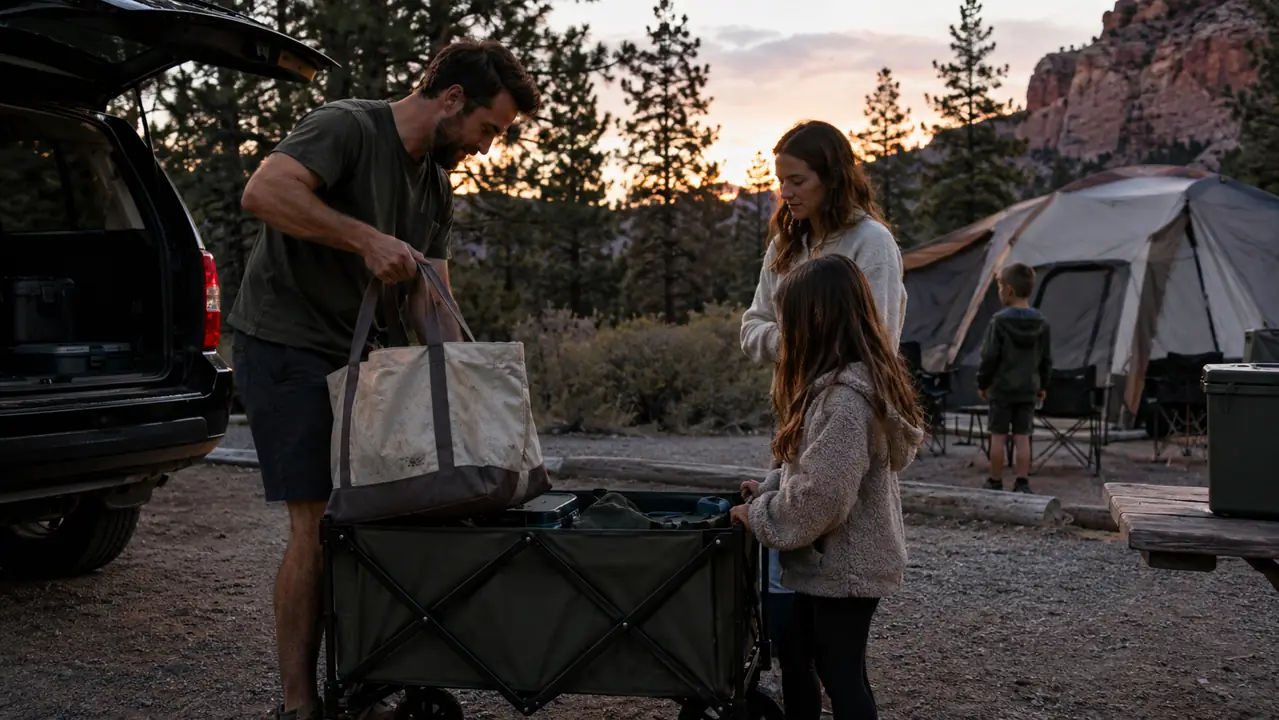
When you have five kids and one Ford Expedition, every trip starts with the same argument: what gets left behind. For years the answer was the wagon. It sat in the garage because I was convinced it would fold once, break twice, and spend the whole weekend as an expensive place to pile jackets. Then our youngest turned four, the 12-year-old decided she was too old to be carried, and the walk from the truck to the campsite turned into a hostage negotiation. I bought the MacSports folding wagon mostly to end that argument. After a full season of state park and national forest camping in Utah, Idaho, and Wyoming, plus one very long road trip, I have opinions that do not match the five-star reviews.
This is the honest version. The MacSports wagon is not a premium off-road cart and it does not pretend to be one. It is a 150-pound-capacity steel-frame utility wagon that folds flat, rolls over packed dirt and gravel well enough, and survives kids. What nobody tells you is how much of your camping life it quietly absorbs, and where exactly it starts to complain.
The Quick Verdict
The MacSports folding wagon is the right call for families who camp from a car and need one tough, boring, dependable cart that hauls everything from firewood to tired kids. Buy it for the steel frame and the fold-flat storage, not for rough trails.
Amazon Check Today's Price →The wagon that ended our walk-to-campsite arguments
After a full season with five kids, the MacSports folding wagon is the piece of gear I would not trade. It folds flat, rolls loaded, and takes whatever a campground throws at it.
Amazon Check Today's Price on Amazon →How I've Used It
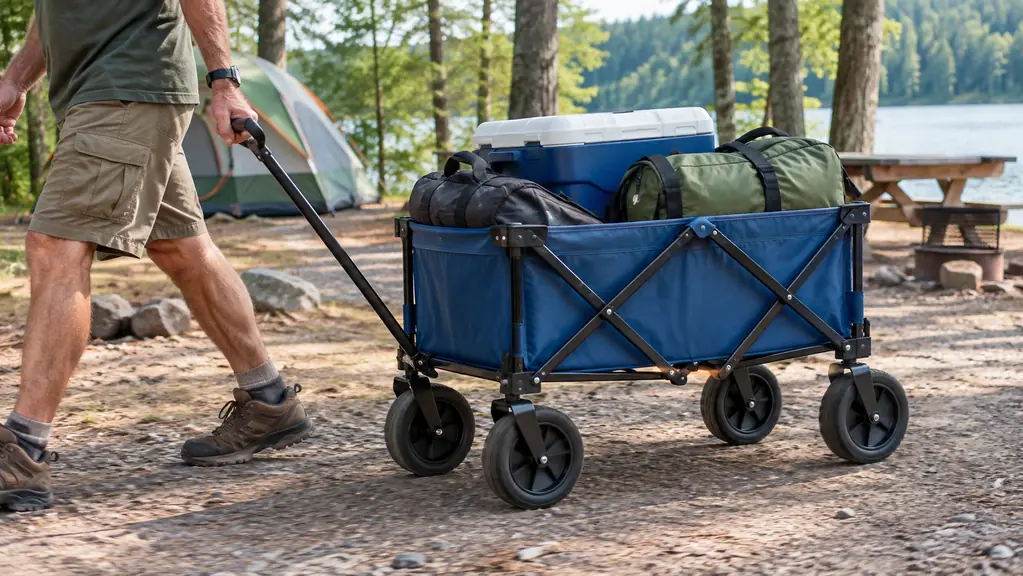
Our summer runs from late May to early September. That is roughly eight trips, most of them long weekends at state parks within two hours of Ogden, plus one ten-day road trip through Wyoming and Idaho. The MacSports wagon came to every one of them. On the Wyoming trip it got loaded and unloaded at four different campgrounds, and by the last one I stopped thinking about it entirely. On a typical Friday afternoon I load it with two coolers, a canvas tote of kitchen gear, the youngest kid's blanket, and whatever the teenagers forgot to pack. That is the wagon's real job: it turns the walk from the Expedition to the tent pad into a single trip instead of four.
I also used it for the jobs nobody advertises. Hauling firewood from the camp store. Moving the camp stove when the wind shifted. Carrying wet towels and muddy shoes back to the car on the last morning so the Expedition did not look like a crime scene. One evening I put our 4-year-old in the wagon for the walk back from the playground because she was done walking and I was done carrying. The 150-pound capacity rating meant nothing to her, but the deep cargo bed meant she could sit flat instead of perching on a cooler.
Before this wagon, our system was a two-wheel hand truck from the garage and a lot of carrying. The hand truck tipped on the path at Bear Lake State Park on the second weekend of June, spilling a full cooler of soda into the dirt, and that was the end of it. We went back to making four trips from the Expedition to the tent pad, which meant the 8-year-old carried things in a grocery bag and the 12-year-old carried things until she decided she was done. The MacSports wagon replaced all of that with one trip, and it has not tipped once, even when the teenagers stacked three camp chairs on top.
The folding mechanism is the feature I was most suspicious about. It is a two-handle pull-and-fold design that collapses the wagon flat in about ten seconds. After roughly twenty fold-and-unfold cycles across the season, the locks still click cleanly and the frame has not developed a wobble. The last fold of the season, on Labor Day weekend at a forest service campground in Idaho, went as cleanly as the first one in May. That surprised me more than anything else on this list.
What Holds Up
The steel frame is the whole story. MacSports builds this wagon around a welded steel tube frame, and you can feel it when you pick it up. It is not light. Empty, it is the kind of thing you notice in the back of the Expedition. But that weight is what makes it feel solid when it is loaded with two coolers and a 12-year-old sitting on the edge. I have never once worried about the frame buckling, and I have loaded it well past what I would call comfortable.
The heaviest load I gave it came on the last morning of the Wyoming trip. Two full coolers, the cast iron skillet, the canvas tote, four camp chairs, and the 12-year-old's duffel bag, which weighed more than the coolers. I guessed it at close to 130 pounds, and the wagon rolled it across a gravel path and up a slight incline without the frame flexing. I did not try to lift it, because I value my back, but I did not worry about the welds either.
The fabric bed has also held up better than I expected. It is a heavy-duty canvas-style material that has survived firewood splinters, a spilled bottle of camp soap, and the 12-year-old dragging it over a curb because she refused to lift. It also spent one night out in a thunderstorm at a site near Flaming Gorge, and by mid-morning the next day it had drained and dried without a saggy spot. The stitching at the corners where the frame attaches is still intact. Those corner seams are the first thing to fail on cheaper wagons, and on this one they have not budged.
The handle deserves its own paragraph. It is a telescoping handle with a foam grip, and it locks at a few different lengths. I am 6-foot-1 and my wife is 5-foot-4, and both of us can pull it without hunching. The handle also rotates through a wide range, which matters more than you would think. When the wagon is fully loaded, the handle angle determines whether you are pulling the weight or fighting it. This one settles into a natural towing angle and stays there.
What Nobody Tells You
Here is the part the product page leaves out. The wheels are the weak point, and they are the weak point in a specific way. They are hard plastic wheels with a solid tread, and they are fine on pavement, packed dirt, and gravel. They are not fine on soft sand, thick mud, or a trail with loose rocks. We hit the soft sand on the third day of the Wyoming trip, at a Bureau of Land Management spot about forty minutes off the highway. The site was beautiful and the last hundred yards were pure sand. The wheels sank to the hubs in the first ten feet, and I had to unload the wagon, pull it empty, and carry the coolers myself. The same thing happened later that month in a muddy patch near the bear box at a forest service site in Idaho. Mud packs into the tread and turns the wheels into slicks. It was not the wagon's fault. No wheel without a wide footprint handles sand or clay well. But the product page does not tell you that, and I am telling you now.
The second thing nobody tells you is that the wagon is wide. It is wider than some campsite paths, and you will learn to read campground layouts differently. At one Idaho campground, the path from our site to the water spigot was bordered by big rocks, and the wagon did not fit through without tilting. The same width is what makes it stable with a kid sitting on the edge, so I would not trade it, but it is a real consideration for tighter sites.
The third thing is the one I did not expect: the wagon becomes a toddler magnet. Every kid in a fifty-yard radius wants to ride in it. Our youngest called it her truck. The neighbor kids at the campsite asked for rides. By the end of the season, the wagon had carried more children than cargo, and that is honestly the highest praise I can give it. A piece of camping gear that keeps a 4-year-old entertained during the boring parts of a trip is worth its weight in firewood.
After a full season, the wagon had carried more kids than cargo. That is the highest praise I can give it.
The Kids' Test
I told you I would tell you what three or more kids will actually notice, so here it is. The 4-year-old notices that she can sit in it and hold her stuffed animal without falling out. The 8-year-old notices that he can help pull it without the handle smacking him in the shins. The 12-year-old notices that she can pile her sleeping bag and pillow in it instead of carrying them, which means she stops complaining about the walk. The teenagers notice that they can stack their camp chairs on top and the wagon does not tip. Those are the real reviews, and they are all positive.
The moment I knew it had passed the kids' test came at a campground near Bear Lake in July. The 4-year-old had fallen asleep in the wagon on the way back from the playground, and I pulled her the last quarter mile in the dark without her waking up. No parent buys a wagon for that, but every parent remembers it.
What the kids also notice, and what I notice watching them, is the turning radius. The front wheels swivel, which makes the wagon easy to steer one-handed while holding a coffee cup. But the swivel wheels also mean the wagon does not track perfectly straight when you are pulling it fast. It wanders a little. A kid pulling it will overcorrect and make it wander more. It is not a problem, it is just a quirk, and it is the kind of quirk you learn to live with after about ten minutes.
What I Liked
- Welded steel frame feels solid even when the wagon is loaded well past comfortable
- Folds flat in about ten seconds and slides behind the third row of the Expedition
- Fabric bed survived a full season of firewood, mud, and a thunderstorm without tearing
- Deep cargo bed lets a tired 4-year-old ride flat instead of perching on a cooler
- Telescoping handle locks at lengths that work for a 6-foot-1 dad and a 5-foot-4 mom
Where It Falls Short
- Hard plastic wheels dig into soft sand, thick mud, and loose rock
- Wide frame does not fit through some narrow campsite paths
- Steel frame makes it heavy to lift into a vehicle when the trip is over
- Swivel wheels wander when pulled fast, and kids overcorrect
- No brake, so it rolls on a slope if you set it down without chocking a wheel
Who This Is For
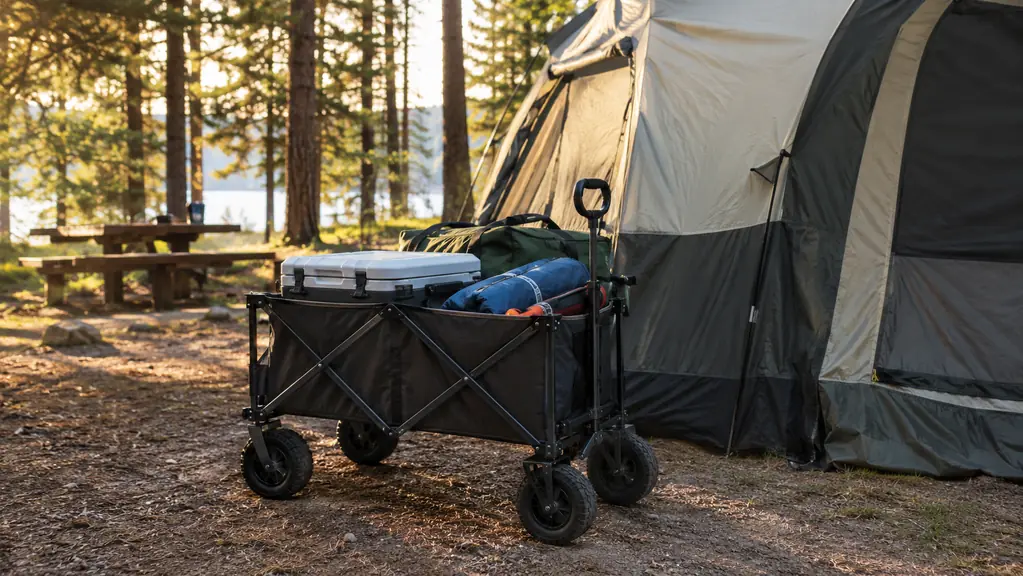
The MacSports folding wagon is for the family that camps from a car, hauls gear across a flat campground, and wants one wagon that does not need to be babied. It is for the parent who is tired of making four trips from the truck to the tent. It is for the parent who wants a wagon that folds flat enough to slide behind the third row of the Expedition with the rest of the gear. It is for the family that will use it for camping, but also for the farmer's market, the kids' soccer games, and the yearly trip to the pumpkin patch. This is a wagon that earns its trunk space.
It is also for the family that does not want to spend premium money on a wagon with oversized balloon tires. The MacSports wagon does not have those. It has honest, simple wheels that roll well on the surfaces most campgrounds actually have. If your camping life is drive-up sites with packed gravel and dirt paths, this wagon is the practical choice, and it costs a fraction of what the big-wheel wagons cost.
Who Should Skip It
Skip the MacSports wagon if your camping involves long hikes to the site. This is a car-camping wagon, not a trail cart. If you are hauling gear a quarter mile over rocks and roots, you want something with bigger wheels and a suspension, and you will pay for it. Skip it if you camp on soft sand regularly. The wheels will dig in and you will spend your trip unloading and reloading. Skip it if you need a wagon that fits through a standard garden gate or a narrow campsite path, because the width is real.
And be honest with yourself about the weight. The steel frame that makes it durable also makes it heavy. If you are the person who has to lift it into the back of the Expedition every time, you will notice it. It is not unmanageable, but it is not a one-finger lift. My wife lifts it fine, and our 12-year-old can drag it, but if you have back problems, this might be the reason to look at a lighter aluminum-framed wagon instead. And if you are not sure a wagon will earn its spot more than once a season, the weight is a good reason to hold off.
How It Compares to the Alternatives
I tested this wagon against two alternatives in my head, because I have owned both. The first is the cheap folding wagon you find at the big-box store, the one with the thin frame and the fabric that sags after one season. I bought one of those in 2021, and by the third trip the fabric had pulled loose at the front corner and the handle would not stay locked. The MacSports wagon is heavier and more expensive, and it is worth every dollar of the difference. The frame does not flex, the fabric does not sag, and the folding mechanism does not jam. If you camp more than twice a year, the cheap wagon is a false economy.
The second alternative is the premium wagon with the big inflatable wheels. Those wagons roll over everything and they cost three times as much. I borrowed one from a neighbor for a weekend at a national forest site in Idaho, and it was genuinely nicer on rough ground. It also weighed noticeably more when I lifted it into the Expedition, and it took up a bigger footprint folded. For our style of camping, which is mostly drive-up sites on packed gravel, the MacSports wagon is the right amount of wagon. The premium wagon is a better tool for a job I do not have.
The wagon that earned its spot in the Expedition
A full season of camping with five kids and the MacSports wagon is still folding flat and rolling straight. If your family camps from a car, this is the wagon to start with.
Amazon Check Today's Price on Amazon →