
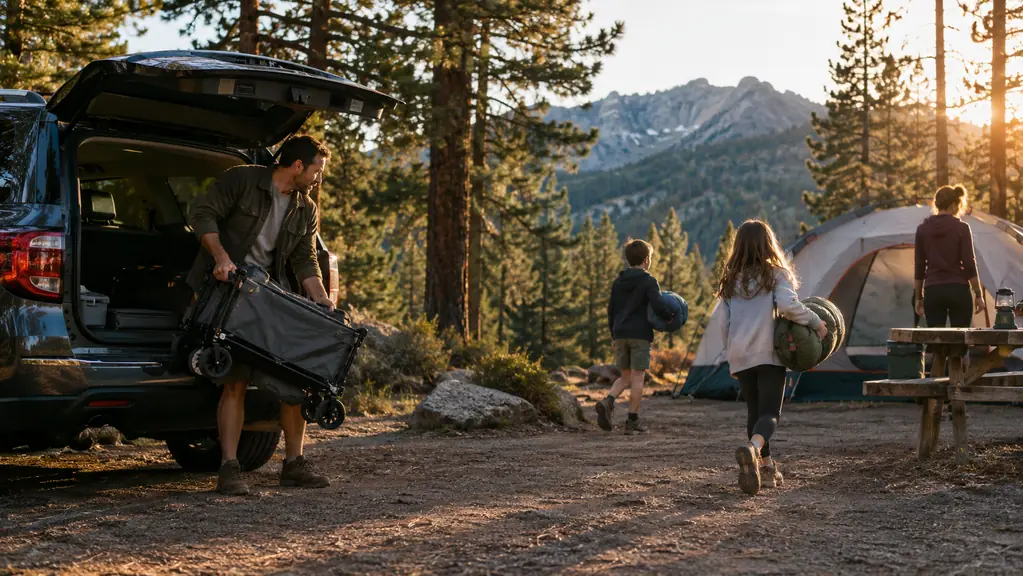
The part of camping I never planned for was the haul. Our Ford Expedition swallows the tent, the sleeping bags, the cooler, the camp stove, the duffel bags, and the bin of camp kitchen stuff without breaking a sweat. Then we park in the overflow lot or the trailhead lot, and every single one of those things has to travel from the bumper to the picnic table. On our first trip with the whole crew, that meant six or seven round trips with arms full of gear, a dropped bag of marshmallows, a stubbed toe on a tent pole, and a cooler that nearly rolled into the creek. By the time we had camp set up, I was already dreading the walk back out on Sunday. That was the summer I started shopping for a wagon.
The MacSports folding wagon is what ended up in the back of the Expedition, and it changed that walk more than any other piece of gear we own. It folds flat enough to slide under the back seat, it pops open in about ten seconds, and it carries a load that used to take me two trips with one of the teenagers helping. This is the exact system we use, trip after trip, from the bumper to the campsite. It is not fancy. It is just what has worked for three summers of state park and national forest campgrounds across Utah, Idaho, and Wyoming, plus one long road trip a year where the rooftop cargo box takes the bulky stuff and the wagon rides flat in the back. If you do most of your camping within a few hundred feet of where you park, this is the piece of gear that makes the difference between a relaxed setup and a frustrating one.
Turn a six-trip haul into one trip
The MacSports Heavy Duty Steel Frame Folding Wagon carries up to 150 pounds of gear, folds flat for the trunk, and has handled every gravel path and dirt road we have put in front of it. It is the wagon that lives in our Expedition all summer.
Amazon Check Today's Price on Amazon →Step 1: Decide what rides in the wagon before you leave the house
Most people treat the wagon as a solution to a problem that starts at the parking lot. We treat it as a packing system that starts in the driveway. Before anything goes into the Expedition, we sort the gear into two piles. One pile is the wagon pile: the tent, the cooler, the water jug, the camp stove, the firewood, and anything else that is heavy, shared, or breakable. The other pile is the hand-carry pile: sleeping bags, pillows, backpacks, and the bag of stuff the kids will need on the drive. The wagon pile stays together in the garage so we are not hunting for the tent poles at 7 in the morning.
The rule in our family is simple. If it is heavy, shared, or breakable, it rides in the wagon. If it is a sleeping bag or a pillow, the kid carries it. That keeps the wagon load honest. The MacSports wagon is rated for 150 pounds, and we have pushed that limit exactly once, on a trip where we tried to haul the tent, the cooler, and a full bag of firewood at the same time. It handled it, but the steering got twitchy on the uphill. Now we keep the load under about a hundred pounds and let the kids carry their own soft stuff.
One more thing we learned the hard way: the wagon has to be the last thing packed and the first thing unloaded. We slide it in flat on top of the gear, right inside the tailgate. That way, when we park, the wagon comes out first and gets opened while the kids are still unbuckling seat belts. It also keeps the wagon from getting buried under a duffel bag full of shoes, which is where it lived for one very annoying trip.
Step 2: Load the heavy stuff low and centered
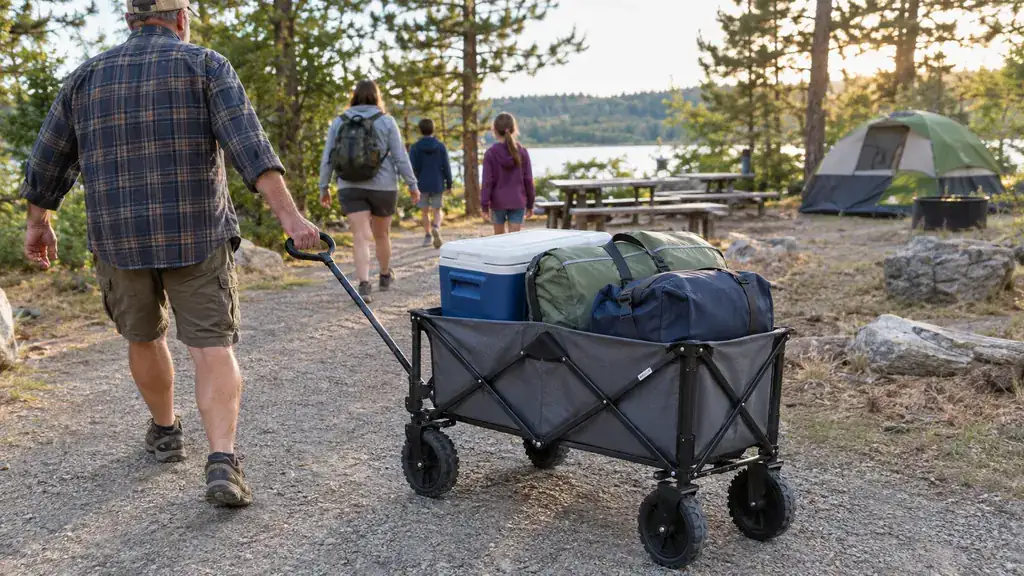
The wagon is basically a steel tray on four wheels, and it pulls best when the weight sits low and balanced. The cooler and the water jug go in first, down in the bottom of the tub, centered side to side. The tent goes in next, lying flat across the cooler. The soft stuff, sleeping bags and duffel bags, goes on top. That order does two things. It keeps the center of gravity low so the wagon does not tip on uneven ground, and it means the heaviest things are the ones the frame is carrying directly. This is the same reason we pack the car the same way, heavy stuff on the bottom, but the wagon is small enough that you can actually feel the difference when you get it wrong.
Balancing side to side matters more than most people think. If you load all the weight on the left side, the wagon wants to pull left on every slope, and you spend the whole walk fighting the handle. If the load is centered, the wagon tracks straight and you barely think about it. We check the balance every time by looking down at the load from the handle end before we start moving. The same goes for front to back. A load that hangs off the back of the tub makes the front wheels light, and the wagon wanders like a shopping cart with a bad wheel.
Also, do not hang stuff off the sides. We tried hooking the camp chairs over the edge of the tub once, and one of them caught a tree root and snapped the fabric clip. Chairs go on top of the load or in a kid's hands. We have a rule about the wagon now: if it does not fit inside the tub, it does not ride.
Step 3: Tie it down before you roll
The wagon has a deep tub, and most loads will stay put on flat ground. Campground paths are not flat ground. Gravel bumps, tree roots, and the occasional rock will bounce the load, and the first time a sleeping bag bounces out and lands in a puddle, you will become a believer in tie-downs. We keep two bungee cords in the side pocket of the wagon at all times. One runs front to back over the load, the other runs side to side. It takes thirty seconds.
You want the cords snug but not crushing. The goal is to stop things from bouncing out, not to compress the sleeping bags into half their size. We also learned to put the cooler lid facing up and the bungee hook on the frame, not on the lid. Hook the frame and the lid stays closed. Hook the lid and you are fishing your lunch out from under a strap.
If you do not have bungees, a couple of the kids' straps from the backpacks work in a pinch, but real bungees are worth it and they live in the wagon full time now. They double as a clothesline when we string them between two trees, so they earn their spot twice.
Step 4: Pull it like a wagon, not a truck
The MacSports handles gravel and packed dirt better than anything else we tried, but it still has limits, and the limits show up on soft ground and steep hills. On a normal gravel path, you just walk at a steady pace and let the wheels do the work. On loose sand or mud, the wheels dig in, and the right move is to take some weight out and make a second trip instead of dragging the whole load through the muck. The only time we ever tipped the wagon was on a slope with the load stacked high, and it was entirely our fault.
Uphill, lean forward into the handle and keep your arms slightly bent. Downhill, the wagon will try to run ahead of you, so walk beside it and let your hand ride the handle rather than gripping it tight. On really rough ground, walk the wagon at an angle across the slope instead of straight up or down. It keeps all four wheels on the ground and stops the load from shifting. If you are pulling for more than a couple of minutes, switch hands every so often. It sounds silly, but a loaded wagon pulls harder than it looks, and a sore wrist is a real camping mood killer by day three.
The other thing we do is scout the path once before we commit. On our first trip to one campground, I picked the shortcut over a dry creek bed and spent ten minutes wrestling the wagon over rocks the size of basketballs. The long way around was flat gravel and took two extra minutes. Now we always take the long way around.
Step 5: Unload in the order you need it
The way you unload the wagon decides how fast camp gets set up. We back the wagon right up to the spot where the tent is going and unload in reverse order of how we packed it. Soft stuff comes off first and goes straight onto the tent footprint. The tent comes out second and gets set up while the light is still good. The cooler and the water jug stay in the wagon until the kitchen spot is chosen.
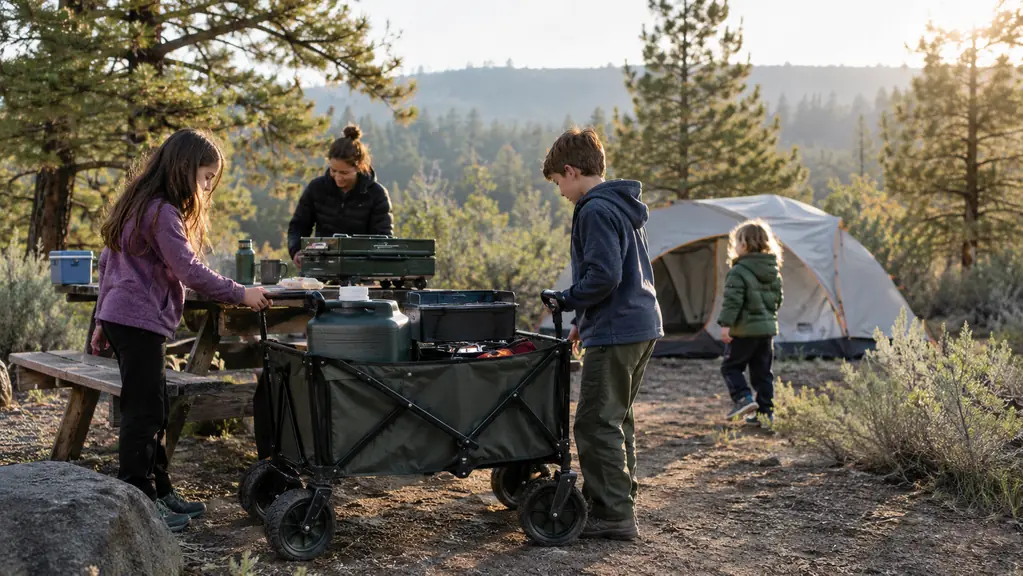
Once the tent is up, we park the wagon next to the picnic table and use it as a mobile kitchen cart for the whole trip. The stove lives in it. The water jug lives in it. The bin of plates and utensils lives in it. When it is time to cook, we roll the whole thing over to the fire ring. When dinner is done, we roll it back. That one habit saved us more steps than anything else we do. On the last morning, the wagon is the first thing we load, and we use it to carry the tent after the dew has dried. That keeps the tent dry and the car clean.
On the way out, the system runs in reverse. The wagon is the last thing packed at home and the first thing unloaded at the campsite, and on departure day it is the first thing loaded and the last thing folded. We fold it flat, stand it against a tree or tuck it under the picnic table while we pack the car, and it goes into the Expedition last so it comes out first next time.
What Else Helps
A few extras made the wagon system better. A small tarp liner keeps the tub clean when we are hauling firewood or dusty gear. A headlamp in the side pocket means the evening haul to the campfire does not require a free hand. And we taught the 12-year-old to pull the wagon on flat ground, which means one fewer trip for the adults and one very proud kid.
The wagon also earns its keep beyond the campsite. We use it to haul firewood from the campground store, to carry the fishing gear down to the river, and to move the camp chairs to the amphitheater for the evening program. It folds flat enough to stand against a tree, and it spends the whole trip within ten feet of the picnic table.
A wagon is not a substitute for a good campsite layout. We still put the tent on the flattest ground we can find and keep the kitchen upwind of the sleeping area. The wagon just makes it easy to move the heavy parts of that layout around until we get it right. One more thing: put the wagon away dry. A wet wagon folded into the back of the Expedition will smell like a swamp by the time you get home.
On a good trip, the wagon turns the walk from the parking lot into a single four-minute trip instead of twenty minutes of back-and-forth.
Make the walk from the car the easiest part of the trip
The MacSports folding wagon has hauled three summers of our family's gear over gravel, dirt, and the occasional dry creek bed. It folds flat, opens in seconds, and carries the cooler and the tent in one trip.
Amazon Check Today's Price on Amazon →